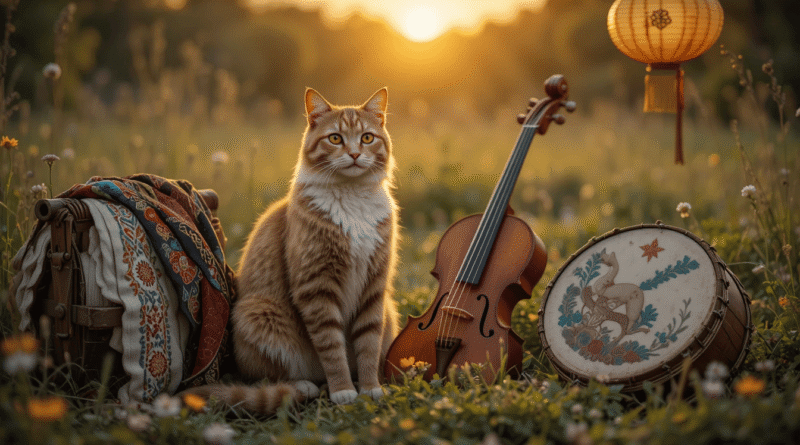
Cats in Folk Music
A Global Journey Through Culture, Symbolism, and Sound
Cats have wandered through human history as companions, protectors, hunters, and mystical figures. Because of this deep bond, they naturally found their way into folk music traditions around the world. Folk songs reflect lived experiences. They preserve emotions, local beliefs, and everyday moments. Since cats shaped daily life in many cultures, artists used them to express humor, sorrow, resilience, affection, or mystery.
As you explore cats in folk music, you discover far more than simple animal references. Instead, you enter a vibrant landscape of symbols, metaphors, and cross-cultural themes that reveal how people understand independence, intuition, community, and the unknown.
The Symbolism of Cats in Folk Music
Independence and Mystery
Cats embody independence. They wander freely, explore shadows, and return home when they choose. Folk musicians use this independence to represent personal freedom, emotional complexity, and life’s unpredictable nature. Their mysterious behavior often parallels hidden truths in folk stories.
Luck, Fortune, and Protection
Cats also symbolize luck across cultures. Black cats sometimes carry misunderstood associations, but in folk traditions, they often represent protection, intuition, and good harvests. Folk songs highlight these themes to show a community’s reliance on signs from nature.
Resilience and Survival
In folk music, cats appear as clever survivors. They fight, hunt, adapt, and endure hardship. Musicians use feline traits to symbolize resilience during difficult times, especially in rural communities where survival was central to storytelling.
Playfulness and Everyday Joy
Folk songs often carry humor. Cats bring charm, mischief, and playfulness. Whether chasing mice or causing chaos in a kitchen, cats offer memorable scenes that inspire rhythmic, catchy lyrics.
Cats in European Folk Music
Europe offers an incredibly rich archive of feline-inspired songs.
British & Celtic Traditions
Cats frequently appear in English, Irish, and Scottish folk tunes. Many songs highlight household life:
- Cats guarding grain stores
- Cats visiting farms
- Cats as companions for children
- Cats as symbols of mystery in Celtic pagan heritage
Celtic folklore also treats cats as guardians of otherworldly gates or messengers between worlds.
Scandinavian Traditions
In Nordic stories, cats connect to magic and domestic warmth. Scandinavian folk songs sometimes reference cats in connection to Norse goddesses like Freyja, who rides a chariot led by two powerful cats.
Eastern European Folk Songs
In Slavic cultures, cats represent protection from evil spirits. Folk lullabies often mention cats to soothe children at night. These references blend comfort with spiritual symbolism, merging the practical and mystical.
Cats in American Folk Music
American folk music includes blues, Appalachian ballads, cowboy songs, and early jazz influences.
Cats in the Blues
Blues musicians use cats metaphorically to describe personality traits. Cats may represent confidence, smoothness, or emotional endurance. Sometimes the “tomcat” symbolizes a bold or clever individual.
Appalachian Folk Songs
Cats appear in humorous Appalachian tales. They sometimes symbolize mischief or cleverness in stories passed down through generations.
Children’s Folk Songs in America
American childhood tunes often feature cats in playful roles. These songs teach rhythm, memory, and humor, which strengthen storytelling traditions.
Cats in African, Middle Eastern, and Asian Folk Music
Africa
Across communities in West and North Africa, cats represent intuition and spiritual awareness. Folk music highlights their ability to sense danger or protect the home. Cats also appear as companions to griots—traditional storytellers—symbolizing wisdom.
Middle East
Middle Eastern folk music sometimes connects cats with dignity, balance, or moral lessons. Their agility represents the ability to navigate life’s challenges.
Asia
Asian folk traditions often depict cats as guardians or guides. In Japan, the Maneki-neko (beckoning cat) inspires songs about prosperity. Chinese folk songs sometimes reference cats as protectors of food stores and companions during the night.
Famous Folk Songs That Feature Cats
European Songs
- “The Cat Came Back” (Origin: Canada & U.S., widely sung in Europe)
- “Ding Dong Bell” (England – one of the oldest nursery rhymes involving a cat)
- “The Fox and the Cat” (Italy – includes feline trickster imagery)
- “Pussycat, Pussycat” (England – iconic children’s rhyme)
American Folk Songs
- “The Old Gray Cat” — A humorous tune sung in early American schools.
- “Froggy Went A-Courtin’” — Many versions include a cat character adding humor.
African & Middle Eastern Songs
- Moroccan Berber folk lullabies — cats appear as night guardians.
- Egyptian folk chants — connecting cats to protection and intuition.
Asian Songs
- Japanese folk song “Neko no Enka” — playful and melodic.
- Indonesian children’s folk rhyme about cats hunting mice — catchy and rhythmic.
Academic-Style Analysis: Why Cats Fit Folk Music So Well
Cats appear consistently in folk music because they sit at the intersection of domestic life, symbolic meaning, and mythology.
They Bridge the Ordinary and the Mythic
Folk music thrives on the blend of everyday experiences and timeless motifs. Cats embody both worlds: familiar household companions and mystical figures in spiritual stories.
They Carry Cultural Flexibility
Cats adapt to different cultural meanings easily. Some traditions portray them as protectors. Others focus on independence, bravery, or mystery. This flexibility gives musicians freedom to embed cats in metaphorical narratives.
They Inspire Rhythm and Imagery
Cats generate physical and visual imagery that fits musical storytelling. Their sounds, movements, and expressions create natural rhythm patterns perfect for folk melodies.
They Represent Emotional States
Writers use cats to express emotional landscapes. A wandering cat represents loneliness. A playful kitten represents joy. A resilient tomcat symbolizes toughness or survival.
They Reflect Human Behavior
Across cultures, people have projected human traits onto cats: curiosity, stubbornness, boldness, or affection. Folk songs explore these parallels with humor or wisdom.
Why Cats Continue to Inspire Modern Folk Artists
Cats continue to appear in contemporary folk, indie-folk, and acoustic music. Today’s artists often use cats to express:
- Self-discovery
- Healing and emotional growth
- Humor and daily life
- Mystery and spiritual symbolism
- Comfort and companionship
They remain powerful symbols because listeners immediately understand them.
Final Thoughts: A Musical Creature Across Generations
Cats occupy a timeless place in folk music. Their presence crosses borders, languages, and belief systems. They inspire creativity, offer emotional depth, and bring both mystery and playfulness to storytelling.
Whether they appear as magical guardians, clever tricksters, loving companions, or symbols of spiritual intuition, cats enrich folk music with meaningful imagery.
Referenes
Books & Academic Sources
- Dundes, Alan. Interpreting Folklore. Indiana University Press, 1980.
- Warner, Marina. No Go the Bogeyman: Scaring, Lulling, and Making Mock. Farrar Straus Giroux, 1999.
- Briggs, Katharine. An Encyclopedia of Fairies. Pantheon Books, 1976.
- Opie, Iona & Opie, Peter. The Oxford Dictionary of Nursery Rhymes. Oxford University Press, 1997.
- Hutton, Ronald. The Stations of the Sun: A History of the Ritual Year in Britain. Oxford University Press, 1996.
- Kvideland, Reimund & Sehmsdorf, Henning. Scandinavian Folk Belief and Legend. University of Minnesota Press, 1988.
- Lomax, Alan. The Folk Songs of North America. Doubleday, 1960.
- Sakata, Hiromi Lorraine. Music in the Mind: The Concepts of Music and Musician in Afghanistan. Kent State University Press, 1983.
- Nketia, J. H. Kwabena. The Music of Africa. Norton, 1974.
- Yamamoto, Chieko. Japanese Folk Songs and Their Cultural Context. Tokyo University Press, 1988.
Cultural & Historical Sources
- European oral tradition archives (British Library Sound Archive; Irish Folklore Commission).
- American Folk Song collections (Library of Congress Folklife Center).
- North African Berber oral heritage recordings.
- Japanese folklore documents (National Diet Library).
- Middle Eastern ethnomusicology studies (various university departments).