Table of Contents
- Why I Wrote This
- What Vets Changed in 2026
- The Lies We’ve All Been Told
- The 70/30 Method Explained Simply
- Exact Portions + Real Costs
- 5 Tricks for Cats Who Hate Water
- Budget Brands Vets Actually Buy
- When Dry Food Only Works
- 3 Dehydration Signs I Missed
- Questions Cat Owners Keep Asking
- Final Thoughts
- Sources
Why I Wrote This
My cat Milo taught me this lesson the expensive way. Eight years old, healthy weight, purring every night on my chest. Then one random Tuesday the vet said his kidneys were failing. The number she gave me made my stomach drop: $2,800 for treatment.
I sat there thinking about every decision I’d made for him. The kibble I bought because it was cheap. The water bowl I filled but never saw him use. The “it’s fine” I told myself when friends said wet food was better. All of it came crashing down in that exam room.
Here’s the truth no one told me: cats are terrible at drinking water. In the wild they get most of their water from prey. In our homes they get dry crunchy food and a bowl of water they ignore. Their bodies compensate for years until they can’t anymore.
I wrote this because I don’t want you sitting where I sat. I don’t want you googling “kidney disease treatment cost” at 2am. The vets changed their advice in 2026 and it’s simple, cheap, and it works. The 70/30 method saved Milo’s life and it’s saving me $500 a year on food.
If you love your cat and you hate vet bills, keep reading. This is everything I wish someone told me before that $2,800 day.
What Vets Changed in 2026
Veterinarians stopped fighting about wet vs dry food this year. The new guidelines from major animal hospitals flipped the whole conversation.
For years the advice was: pick wet or dry, both are “complete and balanced,” do what works for your budget. That advice made sense on paper. But in exam rooms, vets kept seeing the same problem. Cats on dry food with kidney damage at age 7, 8, 9.
The 2026 shift is about priorities. Vets now rank things in this order:
- Get water into the cat. Any way possible.
- Keep weight healthy. Not too fat, not too thin.
- Worry about food format last. Wet, dry, raw… it matters less than the first two.
That third point is huge. It means vets stopped saying “you must feed wet food.” Instead they’re saying “figure out how to get your cat hydrated daily, then we’ll talk about the rest.”
Why the change? Because they realized most owners won’t switch to 100% wet food. It’s expensive, it’s messy, and picky cats refuse it. But most owners will do a hybrid diet if you show them exactly how. And a hybrid diet that cats actually eat beats a “perfect” diet that sits untouched in the bowl.
This is where the 70/30 method came from. Seventy percent of calories from wet food for hydration. Thirty percent from dry food for cost and convenience. Simple math. Huge results.
The Lies We’ve All Been Told
I believed these myths for eight years with Milo. Most cat owners do. Let’s break them down without the vet jargon.
Lie 1: Dry food cleans teeth
I used to buy “dental diet” kibble and feel proud of myself. Turns out kibble shatters when cats bite it. It doesn’t scrape teeth. It barely touches them. The difference in tartar between dry and wet food is tiny. Like brushing your teeth once a month vs once every two months. Neither is enough.
If you want clean teeth, brush them. Three times a week with a finger brush. That does more than any bag of expensive kibble ever will.
Lie 2: Wet food causes diarrhea
My sister told me this and I believed her. “Wet food makes messy litter boxes,” she said. The truth is sudden changes cause diarrhea. Switching brands too fast. Switching from dry to wet overnight. The format doesn’t matter. The transition does.
Wet food actually makes stool softer and easier to pass. Many cats pee more because they’re finally hydrated. That’s a good thing. Dark, tiny pee clumps mean concentrated urine. That’s what hurts kidneys.
Lie 3: Dry food saves money long term
A 15lb bag of kibble costs $40 and lasts two months. Two months of wet food costs $80-$100. On the surface, dry food wins. But one ER visit for dehydration or kidney issues costs $800-$3,000. One. That wipes out ten years of kibble “savings.”
Prevention is boring and cheap. Treatment is exciting and bankrupts you. I learned that the hard way.
Lie 4: Cats drink when they’re thirsty
Cats are desert animals. Their bodies evolved to survive with very little water. They don’t feel thirsty until they’re already dehydrated. By the time your cat looks thirsty, their kidneys have been working overtime for weeks.
Waiting for thirst is like waiting for your car engine to smoke before you check the oil. Too late.
The 70/30 Method Explained Simply
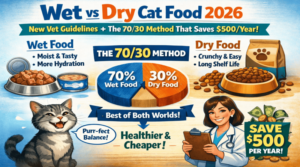
This is the part that changed everything for Milo. Seventy percent wet food. Thirty percent dry food. That’s it.
Vets landed on this ratio because it’s realistic. 100% wet food is perfect but expensive and hard to manage. 100% dry food is cheap but risky. 70/30 gives you most of the hydration benefits at half the cost.
Here’s how it works in real life:
Morning: You feed wet food. One half of a 5.5oz can. Add two tablespoons of warm water and stir. It becomes “cat soup.” Milo laps it up.
Daytime: You leave a small measured portion of dry kibble out while you’re at work. One quarter cup for a 10lb cat. He grazes when he wants.
Evening: Second half of the wet food can. More water mixed in. More hydration before bed.
The wet food covers 70% of his daily calories and most of his water needs. The dry food covers the other 30% of calories and gives me peace of mind when I’m not home.
Three rules to make 70/30 work:
- Measure the dry food. Don’t free-feed. Use a 1/4 cup measuring scoop.
- Add water to wet food. Every single meal. Two tablespoons minimum.
- Transition slow. Mix new food with old food over ten days so his stomach doesn’t freak out.
Milo’s kidney values improved in six months. The vet was shocked. I wasn’t. He was finally getting water without realizing it.
Exact Portions + Real Costs
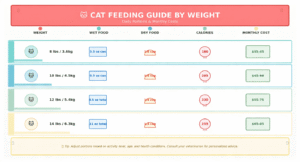
Let’s talk numbers because vague advice helps no one. Here’s what 70/30 looks like for different cat weights. Costs are based on mid-range brands you can buy at PetSmart or Chewy.
| Cat Weight | Wet Food Per Day | Dry Food Per Day | Total Calories | Monthly Cost |
|---|---|---|---|---|
| 8 lbs / 3.6kg | 3.5 oz can | 1/8 cup | 180 | $35-45 |
| 10 lbs / 4.5kg | 5.5 oz can | 1/4 cup | 205 | $45-60 |
| 12 lbs / 5.4kg | 8.5 oz total | 1/4 cup | 230 | $55-75 |
| 14 lbs / 6.3kg | 11 oz total | 1/3 cup | 255 | $65-85 |
If your cat is active or outdoor, add 20% more. If they’re senior and sleepy, subtract 10%. Your vet can fine-tune this based on body condition.
Money hack: Buy 13oz cans instead of 5.5oz if your cat eats two cans daily. Cost per ounce drops by about 25%. Store leftovers in glass containers in the fridge for up to five days. Never microwave it. Warm it by sitting the container in hot water for two minutes.
For a 10lb cat, 70/30 costs about $50/month. 100% wet food costs $90/month. 100% premium dry costs $40/month. You’re paying $10 more than dry-only for kidney protection that could save you $2,800 later. That math works for me.
5 Tricks for Cats Who Hate Water
Milo wouldn’t touch his water bowl. I’d fill it, he’d sniff it, walk away. I thought he was broken. Turns out he’s just… a cat.
Here are five things that actually worked. Vets told me these and I tested them:
1. Get a cat fountain
Cats prefer moving water. In nature, still water might be dirty. Running water means fresh. I bought a $25 fountain on Amazon. Within two days Milo was drinking four times a day. The sound of water actually makes him come running.
2. Make “cat ice cubes”
Freeze low-sodium chicken broth in an ice cube tray. Drop one cube in his water bowl. It flavors the water and melts slowly. He thinks it’s a treat. Just make sure the broth has no onion or garlic.
3. Serve cat soup
This is my favorite trick. Add two tablespoons of warm water to every wet food meal and stir. It turns pate into soup. Milo doesn’t notice and he gets an extra quarter cup of water daily without trying.
4. Use wide plates
Cat whiskers get stressed in deep bowls. It’s called whisker fatigue. Switch to a wide, shallow plate. I use a cheap cereal bowl. Suddenly he drinks way more.
5. Put water everywhere
One water bowl in the kitchen isn’t enough. Put bowls in three places: where he sleeps, where he plays, where he eats. Cats drink more when water is convenient. Think like a lazy cat.
Try one trick for a week. If it works, keep it. If not, try the next one. The goal is more water, not perfection.
Budget Brands Vets Actually Buy
I’m not going to pretend I feed Milo $4 cans of imported rabbit meat. I have a budget. You probably do too. Vets are honest about this: the best food is the food your cat will eat and you can afford long term.
Wet food under $0.70 per can:
Fancy Feast Classic Pate. Friskies Pate. These aren’t fancy but they’re nutritionally complete. The Classic line has no grains. Vets tell me they’d rather see a cat eat Fancy Feast than starve waiting for expensive food.
Wet food $1.00-$1.40 per can:
Wellness Complete Health. Purina Pro Plan. Tiki Cat. Better meat content, fewer fillers. This is what I feed Milo now. Good balance of price and quality.
Dry food under $0.40 per cup:
Purina Cat Chow. Meow Mix. If you’re doing 30% dry, these work fine. The risk isn’t the brand. The risk is no water.
Dry food $0.70-$1.00 per cup:
Hill’s Science Diet. Royal Canin Indoor. Iams Proactive. Better protein sources and added kidney support. Worth it if dry food is 30% of the diet.
Mix brands if you need to. One premium can plus one budget can equals a happy cat and a happy wallet. The 70/30 method works even if you mix prices.
When Dry Food Only Works
Let’s be fair. Some cats do fine on 100% dry food. I’ve met them. They drink water like camels. Their bloodwork is perfect at age 15. If that’s your cat, don’t panic and change everything.
Dry-only is okay if three things are true:
- Your cat actually drinks water every day. Measure it. If a 10lb cat drinks eight ounces of water daily, dry food is less dangerous.
- You add water to the kibble. Pour warm water on it and let it sit five minutes. Most cats accept it if you start young.
- Your vet says kidney values look perfect year after year. Bloodwork doesn’t lie.
But if your cat ignores water, pees tiny dark clumps, or has had urinary issues before, dry-only is gambling. And I’m done gambling with Milo’s kidneys.
The 70/30 method isn’t about being extreme. It’s about stacking the odds in your cat’s favor. Small change. Big protection.
3 Dehydration Signs I Missed
I missed these signs with Milo. Don’t make my mistake. Check your cat once a week. Takes thirty seconds.
1. The skin test
Pinch the skin on the back of his neck and lift. If it snaps back right away, he’s hydrated. If it stays tented for two seconds, he needs water. I do this every Sunday now.
2. Gum check
Lift his lip. Healthy gums are pink and wet. Dehydrated gums are pale and sticky. Press your finger on the gum. Color should return in one second. Longer means dehydration.
3. Litter box clues
Small, dark pee clumps mean concentrated urine. That’s the body trying to save water. Peeing outside the box can mean urinary pain from dehydration. If litter habits change, call the vet.
If you see two of these three signs, add water to food immediately and make a vet appointment. Early catch means cheap treatment. Late catch means expensive treatment.
Questions Cat Owners Keep Asking
Is dry cat food bad for cats in 2026?
Dry food isn’t evil. It’s convenient and cheap. The problem is most cats don’t drink enough water to balance it. Vets in 2026 recommend using dry food for 30% of calories and getting the other 70% from wet food. That way your cat gets hydration without breaking your budget.
How much wet food does my cat actually need?
A 10lb indoor cat needs about one 5.5oz can of wet food daily plus one quarter cup of dry kibble. That gives roughly 205 calories. Active cats need more. Lazy senior cats need less. Your vet can calculate exact calories based on your cat’s body shape.
Can my cat live on dry food only?
Some can, but most shouldn’t. Cats on dry-only must drink a lot of water daily to stay safe. Most don’t. If you choose dry-only, you have to add water to the kibble and get bloodwork done yearly to catch kidney issues early. The 70/30 method is safer for most cats because it builds hydration into every meal.
My cat refuses wet food. What now?
Go slow. Mix ten percent wet food with ninety percent dry food for three days. Then twenty-eighty. Then thirty-seventy. Try different textures too. Some cats hate pate but love shredded meat. Warm the food slightly to make it smell stronger. If he still refuses after two weeks, focus on adding water to dry food and getting a cat fountain.
Will 70/30 really save me $500 a year?
Compared to feeding 100% wet food, yes. A 10lb cat on all-wet costs about $90 per month. The 70/30 method costs about $50 per month. That’s $480 saved yearly. Plus you lower the risk of expensive kidney disease treatment down the road.
Bottom Line for Cat Owners
Milo is ten now. His kidney numbers are stable. He still purrs on my chest every night. The difference is what’s in his bowl.
I’m not here to shame anyone for feeding dry food. I did it for eight years. I’m here to tell you what I learned after that $2,800 vet bill. Vets changed their advice in 2026 because they got tired of watching preventable kidney disease ruin cats’ lives.
The 70/30 method isn’t perfect. But it’s realistic. You can afford it. Your cat will eat it. And it protects their kidneys in a way dry-only never will.
Start small. Buy one can of wet food today. Mix it with warm water. See if your cat likes it. Tomorrow add a quarter cup of dry food measured with a scoop. In ten days you’ll have a new routine that could add years to your cat’s life.
That’s worth $50 a month to me. I hope it’s worth it to you too.