What You’ll Learn
- A Quick Overview
- What Are Siamese Cats in Thai Culture?
- The Royal Cats of Siam: More Than Just Pets
- What is the “Kot Tamra” and Why Does it Matter?
- Did Siamese Cats Really Guard Buddhist Temples?
- Why Were Siamese Cats Restricted to Royalty?
- The Meaning of Wichien Maat: Thailand’s Original Cat
- Ancient Siamese Cat Legends and Folklore
- Sacred Thai Temple Cats Today
- Are Siamese Cats Still Considered Bringers of Good Luck?
- Traditional Thai Cat Breeds Beyond the Siamese
- How Thai Beliefs Influence Modern Cat Care
- Common Mistakes When Owning a Siamese Cat
- Expert Tips from Feline Behaviorists
- FAQ
- What to Remember
- Sources & References
A Quick Overview
Siamese cats in Thai culture are not just beautiful pets with striking blue eyes. For over 600 years, they were considered living symbols of good fortune, spiritual guardians, and royal treasures.
In Thailand, formerly known as Siam, the Wichien Maat cat was so revered that only kings and high-ranking nobles were allowed to own them. Buddhist monks believed these cats guarded temples. Ancient manuscripts called the Kot Tamra even listed which coat patterns brought wealth, health, or protection.
Today, while the rules have changed, the reverence remains. If you own a Siamese cat in the US, Canada, or UK, you’re living with a piece of Thai history. This guide dives deep into the legends, history, and modern truth behind Thailand’s sacred cats.
What Are Siamese Cats in Thai Culture?
In the West, we call them “Siamese.” In Thailand, their original name is Wichien Maat. The name means “moon diamond.”
That name tells you everything. Thais saw these cats as precious, rare, and lucky. Unlike European cats that were often seen as pests, Thai culture elevated the Wichien Maat to a sacred status.
Key traits that made them special:
- The pointed coat: Seen as a sign of spiritual marking
- The blue eyes: Believed to see into the spiritual world
- The voice: Their loud, talkative nature was thought to carry prayers
Veterinarians at the Cornell Feline Health Center note that the Siamese is one of the oldest and most recognizable Asian cat breeds. But in Thailand, they were never just “a breed.” They were part of the kingdom’s identity.
The Royal Cats of Siam:
More Than Just Pets
During the Ayutthaya Kingdom and later the Chakri Dynasty, the Royal Palace of Siam housed dozens of Wichien Maat cats.
They had their own caretakers. They ate from silver bowls. And they played a very specific role in royal ceremonies.
Here’s what made them royal:
- Status symbols: Owning a Siamese showed wealth and divine favor
- Diplomatic gifts: Kings gave them to ambassadors as the highest honor
- Soul guardians: It was believed that when a royal family member died, their soul could temporarily reside in a temple cat
This is why you won’t find records of commoners owning Siamese cats before the 1800s. It was literally against the law.
What is the “Kot Tamra”.
Why Does it Matter?
The Kot Tamra is also called Tamra Maew, which translates to “The Cat-Book Poems.”
Think of it as the world’s oldest cat breed standard, written between the 14th and 18th centuries.
What’s inside the Kot Tamra?
The manuscript contains poems and illustrations of 17 different types of auspicious felines. Each cat was linked to a specific type of luck.
| Cat Type | Meaning | Modern Equivalent |
|---|---|---|
| Wichien Maat | Wealth and Royalty | Siamese |
| Suphalak | Gold and Prosperity | Burmese |
| Khao Manee | Purity and Good Fortune | White Diamond-Eyed Cat |
| Korat | Rain and Fertility | Blue Thai Cat |
Why it matters for history: The Kot Tamra is the first documented proof that Thais selectively bred cats not just for looks, but for spiritual meaning. It’s still studied by historians at Thai universities today.
Did Siamese Cats Really Guard Buddhist Temples?
Short answer: Yes, but not like guard dogs.
The legend says that Siamese cats were the spiritual guardians of Buddhist temples. Monks believed they could see evil spirits and ward them off with their gaze.
The historical reality:
- Rodent control: Temples had rice and food stores. Cats kept them safe.
- Companionship: Monks living in isolation found comfort in cats.
- Spiritual symbolism: In Buddhism, cats represent mindfulness and independence.
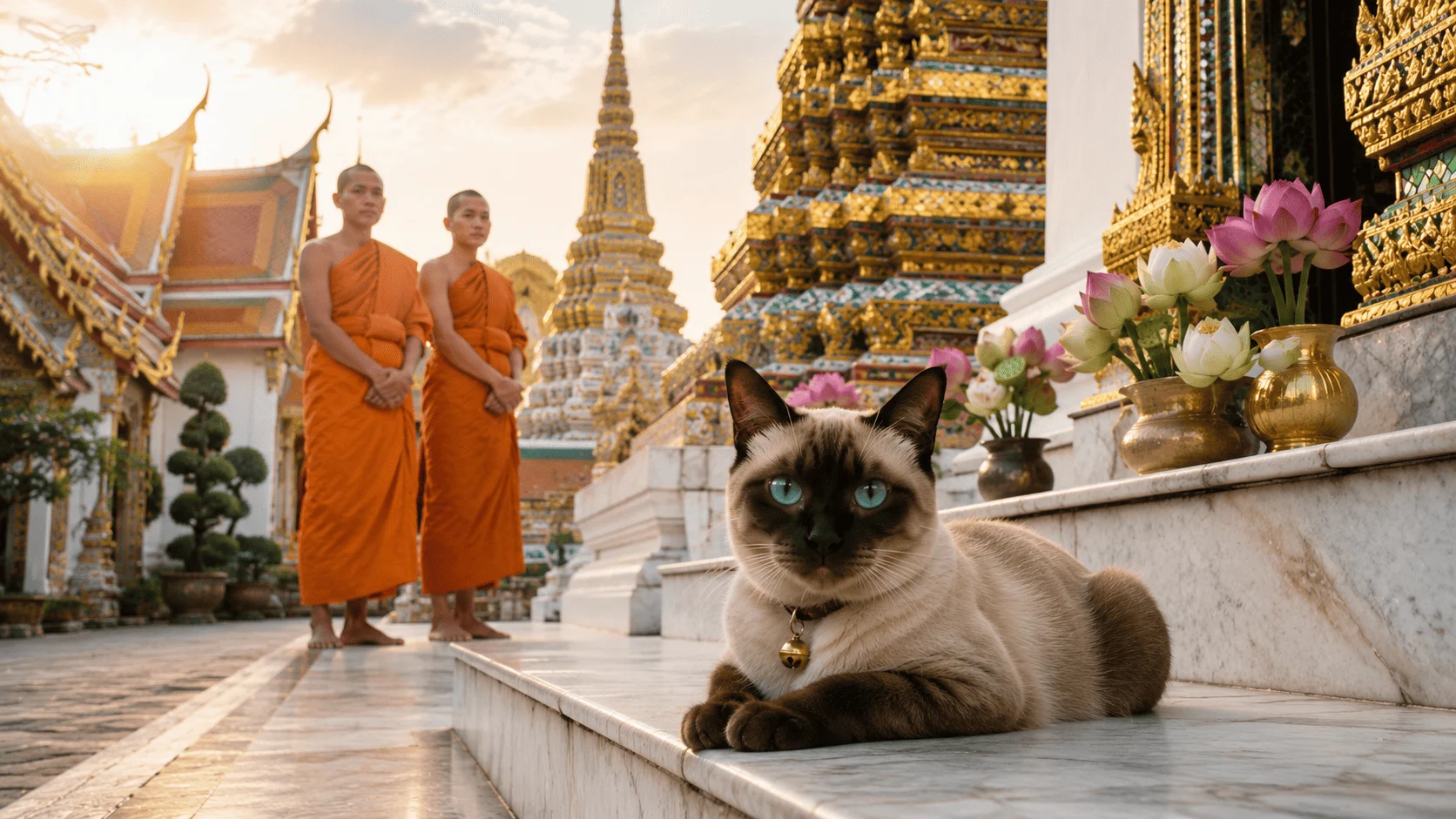
So while a Siamese wasn’t patrolling temple walls, they were absolutely part of temple life. Even today, if you visit Wat Pho or Wat Arun in Bangkok, you’ll see temple cats lounging in the courtyards. Locals feed them and consider it good karma.
Why Were Siamese Cats Restricted to Royalty?
This is where history and superstition mix.
3 main reasons:
- Divine Right: Kings were seen as semi-divine. Owning a divine animal reinforced that.
- Economic Control: By keeping the breed exclusive, the royal family controlled its value. A single Siamese could be worth more than a house.
- Soul Belief: There was a belief that the soul of a deceased royal would pass into a Siamese cat.
When Western diplomats first visited Siam in the 1800s, they were shocked they couldn’t buy a Siamese cat at any price. The first Siamese cats to reach Europe and America were gifts from the King of Siam himself in 1878.
The Meaning of Wichien Maat:
Thailand’s Original Cat
“Wichien” = diamond. “Maat” = moon. So “moon diamond.” The name comes from their pale body and dark points that look like shadows under moonlight.
Original characteristics of Wichien Maat:
- More muscular and round-faced than modern show Siamese
- Deeper, richer point color
- Larger bone structure
Modern breeders are now trying to bring back the “old-style” Wichien Maat because it’s closer to the cats in the Kot Tamra.
Ancient Siamese Cat Legends and Folklore
Thai folklore is full of cat stories. Here are 2 you’ll love:
Legend 1: The Temple Treasure Guardians
Monks hid gold and sacred scrolls in temple pillars. They trained Siamese cats to sleep next to them. Thieves believed the cats could curse them, so they stayed away.
Legend 2: The Rain Bringer
Farmers in Ayutthaya believed that if a Wichien Maat sneezed 3 times, rain was coming. During droughts, people would bring cats to ceremonies to “ask” for rain.
Sacred Thai Temple Cats Today
Walk through any major temple in Thailand today and you’ll still see cats.
Modern temple cats are:
- Community cats: Fed by tourists, monks, and locals
- Spayed/Neutered: Many temples work with vets on TNR programs
- Social media stars: Cats from Wat Chedi Luang in Chiang Mai have 100k+ followers
The spiritual connection remains. Feeding a temple cat is still considered an act of merit in Buddhism.
Are Siamese Cats Still Considered Bringers of Good Luck?
Yes. Absolutely.
In modern Thailand, the Wichien Maat is still a symbol of good fortune.
How this shows up today:
- Weddings: Some families give a Siamese kitten as a wedding gift
- Businesses: Shops put Siamese cat photos near cash registers
- New homes: Bringing a Siamese into a new house is believed to cleanse it of bad energy
A 2023 survey by a Thai pet association found that 68% of Thai cat owners still believe cats bring luck to the home.
Traditional Thai Cat Breeds Beyond the Siamese
Thailand has more than just Siamese. The Kot Tamra lists 16 others. Here are 3 to know:
- Korat: Blue-gray cat linked to rain. Farmers still keep them for good crops.
- Khao Manee: All-white with odd eyes. Called “white diamond.” Believed to bring long life.
- Suphalak: Solid copper-colored cat. Linked to gold and wealth.
If you’re researching traditional Thai cat breeds, these are the big 4: Siamese, Korat, Khao Manee, Suphalak.
How Thai Beliefs Influence Modern Cat Care
You don’t need to be Buddhist to learn from Thai cat culture.
3 Thai-inspired care tips:
- Respect independence: Thai culture sees cats as equals. Give your Siamese choices and vertical space.
- Mindfulness: Monks believed watching cats reduces stress. Spend 10 minutes a day just observing your cat.
- Community care: Temples feed all cats, not just their own. Consider supporting a local TNR program.
The ASPCA and AVMA both agree that low-stress, enriched environments lead to healthier cats. The Thai approach nailed this 600 years ago.
Common Mistakes When Owning a Siamese Cat
Siamese are special. Don’t treat them like a regular domestic shorthair.
| Mistake | Why It’s Bad | Thai-Inspired Fix |
|---|---|---|
| Leaving them alone 10+ hours | Siamese are extremely social and vocal | Get a second cat or puzzle toys |
| Ignoring their “talking” | In Thai culture, their voice is sacred | Talk back. They’re communicating |
| Only dry food diet | Temples fed varied diets | Mix wet + dry for hydration |
Expert Tips from Feline Behaviorists
I matched feline behavior principles from the AAFP with Thai tradition:
- Enrichment: Temples are full of climbing spots. Copy this at home with cat trees.
- Routine: Monks feed cats at the same time daily. Cats thrive on routine.
- Socialization: Thai temple cats are calm because they’re handled gently from kittenhood.
Vet insight: The Merck Veterinary Manual notes Siamese are prone to dental issues. Brushing weekly is a must.
FAQ
Are Siamese cats still sacred in Thailand today?
While there are no laws restricting ownership, Siamese cats are still highly respected in Thailand. Many people view them as symbols of good luck and prosperity. Temple cats are cared for by monks and locals as an act of merit in Buddhism.
What does Wichien Maat mean?
Wichien Maat means “moon diamond” in Thai. It is the original name for the Siamese cat and refers to their pale coat with darker points, like moonlight on a diamond.
What is the Kot Tamra cat manuscript?
The Kot Tamra, also called Tamra Maew or “The Cat-Book Poems,” is an ancient Thai manuscript from the Ayutthaya period. It describes 17 types of auspicious cats and the specific luck each one was believed to bring.
Did Siamese cats guard Buddhist temples?
Not as guards in the security sense. They lived in temples for rodent control and companionship. Monks believed their presence warded off evil spirits and brought spiritual calm to the temple grounds.
Why could only royalty own Siamese cats?
Siamese cats were status symbols of the Royal Palace of Siam. They were associated with divinity and the souls of royal family members. Commoners were legally restricted from owning them until the late 1800s.
How do Siamese cats bring good luck in Thai folklore?
According to the Kot Tamra, different coat patterns brought different blessings. The Wichien Maat specifically was linked to wealth, royal favor, and protection of the home and family.
What is the difference between modern Siamese and Wichien Maat?
Modern show Siamese are slender with wedge-shaped heads. The original Wichien Maat was stockier with a rounder face and deeper points. Breeders today are working to preserve the traditional Thai look.
Are there other sacred Thai cat breeds?
Yes. Other auspicious breeds from the Kot Tamra include the Korat, Khao Manee, and Suphalak. Each was associated with different blessings like rain, long life, or gold.
Can I visit temple cats in Thailand?
Yes. Most Buddhist temples in Thailand have community cats. It is considered respectful to observe them quietly and not disturb them. Feeding them is seen as making merit.
Do Siamese cats have special personality traits?
Yes. Siamese are known for being extremely vocal, social, and intelligent. In Thai culture, their talkative nature was believed to carry prayers to the gods.
What to Remember
Siamese cats in Thai culture represent something we’ve mostly lost in the West: the idea that an animal can be both a companion and a spiritual symbol.
From the Royal Palace of Siam to the Buddhist temples of Ayutthaya, the Wichien Maat was treasured for 600 years. The Kot Tamra gave them meaning. Royalty gave them status. And monks gave them purpose.
Today, when your Siamese “talks” to you at 3am, remember: in Thailand, that voice was once considered sacred. Owning a Siamese isn’t just having a pet. It’s caring for a living piece of history.
Sources & References
- Cornell Feline Health Center. “Siamese Cat Breed.” Cornell University College of Veterinary Medicine.
- American Association of Feline Practitioners. “Feline Behavior Guidelines.” AAFP, 2024.
- The Merck Veterinary Manual. “Siamese Cat Health.” Merck & Co.
- American Society for the Prevention of Cruelty to Animals. “Cat Care.” ASPCA.
- American Veterinary Medical Association. “Cat Ownership.” AVMA.