From Cat Cafés to Cat Lounges
What if a place designed for cat lovers could become much more than somewhere to enjoy a coffee and spend a few minutes with cats? Around the world, a new generation of cat lounges is beginning to answer that question by bringing together cats, adoption, rescue organizations, events, and local communities in increasingly creative ways.
Traditionally, cat cafés were built around a simple idea: enjoy a drink, relax in the company of cats, and experience something different from an ordinary café. However, that concept is evolving. Today, animal adoption, community activities, education, and meaningful human-animal connections are becoming much more important parts of the experience.
This shift is especially interesting because a cat lounge does not always need to operate like a traditional café. Instead, the space can become a flexible community environment where people meet adoptable cats, attend events, learn about responsible pet ownership, support rescue organizations, or simply enjoy a calm atmosphere surrounded by animals.
Why Cat Lounges Are Getting More Attention
Recent examples in New Jersey show how this idea is developing. For instance, Catcetera Cat Lounge in Raritan has attracted attention for combining adoptable cats with community-focused programming. Meanwhile, other venues are experimenting with café-and-lounge models that connect visitors directly with local animal rescue organizations.
As a result, the modern cat lounge can serve several purposes at once. It can be a relaxing destination for cat lovers, a meeting point for local residents, a platform for rescue organizations, and a potential pathway toward adoption.
So, are cat lounges becoming the next evolution of cat cafés? More importantly, could they create a stronger connection between cats, potential adopters, rescue groups, and the communities around them? To understand where this trend is heading, it is worth looking beyond the coffee counter and exploring the changing role of the modern cat lounge.
Explore This Article
1. From Cat Cafés to Cat Lounges
2. Why Adoption Is Becoming Central
3. A More Relaxed Way to Meet Adoptable Cats
4. Cat Lounges as Community Spaces
5. The Example of Catcetera
6. Rescue Partnerships Create a Stronger Model
7. Why Cat Lounge Directories Matter
8. What Visitors Should Look For
9. The Future of Cat Lounges
10. A New Kind of Cat Community
From Cat Cafés to Cat Lounges
For years, the phrase “cat café” described a fairly recognizable experience. Visitors could order a drink, spend time around cats, take photographs, and enjoy a few peaceful moments with animals. The concept became popular in different parts of the world, especially as people looked for new ways to experience cats without necessarily owning one.
Today, however, the idea is becoming more flexible. The term cat lounge can describe a space where the relationship between people and cats matters more than the café itself. Some venues still serve coffee and other refreshments, while others focus almost entirely on interaction, relaxation, events, and adoption.
This distinction is important because a lounge can create a different atmosphere. Rather than making food and beverages the main attraction, the venue can put cats, visitors, and community activities at the center of the experience.
In addition, the lounge model gives businesses more freedom to create specialized experiences. A venue might organize quiet sessions for visitors who prefer a calmer environment, for example, or host educational activities, creative events, social gatherings, or adoption-focused sessions.
Consequently, the modern cat lounge is not necessarily a replacement for the cat café. Instead, it is an expansion of the idea. The common thread is simple: people come together because they enjoy the company of cats.
Why Adoption Is Becoming Central
One of the most interesting developments in the cat lounge movement is the growing connection with animal adoption. Instead of simply displaying cats for entertainment, some venues provide a temporary environment where adoptable cats can meet potential families.
That approach can benefit both sides. Visitors get an opportunity to observe cats in a relaxed setting, while rescue organizations gain another place where their animals can meet people who may eventually adopt them.
More importantly, adoption can become part of the normal visitor experience rather than a separate process hidden behind shelter doors. Someone may arrive simply because they love cats and leave with a completely different understanding of a particular animal.
Of course, visiting a lounge does not mean that every guest should adopt. Responsible venues should make adoption thoughtful rather than impulsive. Nevertheless, regular interaction can help people understand what living with a cat actually involves.
As a result, cat lounges can serve as a bridge between the public and rescue organizations. They bring adoptable cats into a social environment while maintaining a connection to the organizations responsible for their care.
A More Relaxed Way to Meet Adoptable Cats
Choosing a cat is not always easy. Shelter environments can be stressful, and some cats may behave differently when they are surrounded by unfamiliar sounds, people, and other animals.
A well-designed lounge can offer a different setting. Cats may have room to move, climb, rest, hide, observe visitors, or approach people when they feel comfortable. Therefore, guests may have more opportunities to notice individual personalities.
For example, one cat might immediately approach a visitor, while another may stay nearby and watch quietly. A third cat could become playful after several minutes. These small differences can help potential adopters understand that every cat has its own temperament.
At the same time, a lounge must put animal welfare first. Cats need suitable hiding places, resting areas, food, water, enrichment, veterinary care, and protection from excessive handling. Visitor rules are therefore more than simple house policies; they help maintain a healthy environment for the animals.
Ultimately, the best adoption-focused lounges do not pressure visitors. Instead, they create opportunities for genuine connections to develop naturally.
Cat Lounges as Community Spaces
Adoption is only one part of the story. Increasingly, cat lounges are also becoming places where people can participate in activities that have little to do with buying something.
This is where the word “community” becomes especially important. A successful lounge can give local residents a reason to return even when they are not looking for a new pet.
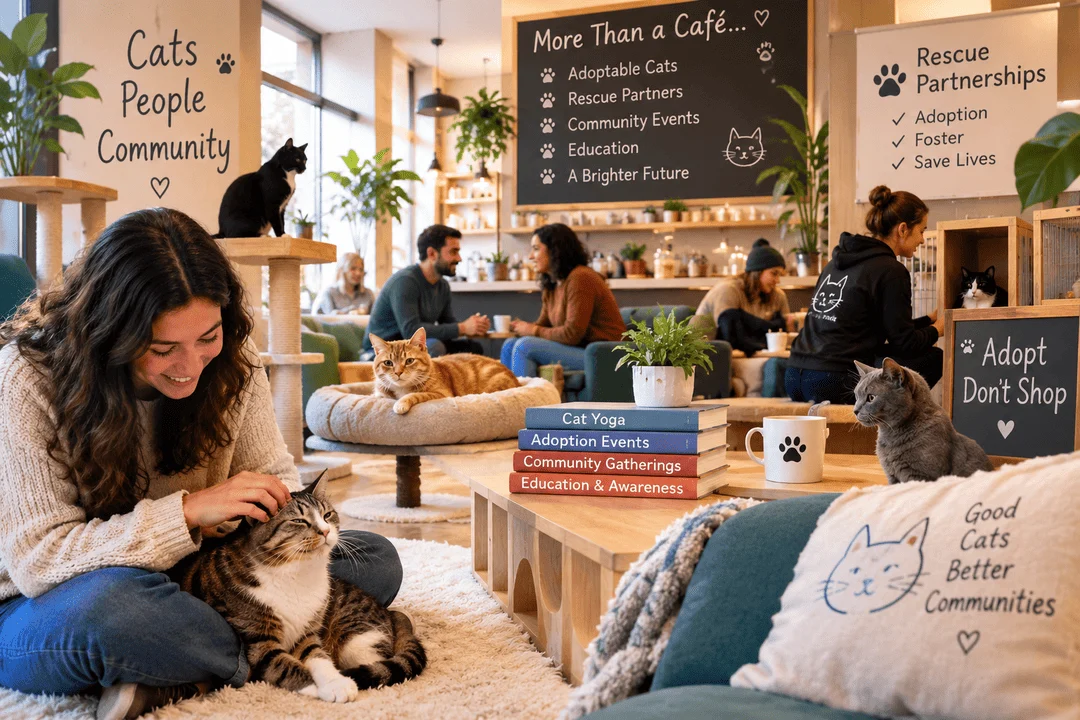
For instance, a lounge might host book discussions, creative activities, yoga sessions, quiet hours, children’s programs, senior gatherings, or evening social events. These activities create different entry points for different groups of people.
Meanwhile, cats naturally become part of the atmosphere. Their presence can make an ordinary community event feel distinctive, memorable, and emotionally engaging.
Another advantage is that these spaces can encourage conversations between people who might otherwise never meet. Cat lovers often have an immediate shared interest, which makes starting a conversation easier.
In that sense, a cat lounge can function as a small local social hub. The cats are the attraction, but the relationships formed around them can become an equally important part of the experience.
The Example of Catcetera: When a Cat Lounge Becomes a Community Hub
A particularly useful example appeared in 2026 with Catcetera Cat Lounge in Raritan, New Jersey. CNN Arabic featured the venue in July 2026 in a report about how the space connects a love of cats with a warm community experience.
Catcetera describes itself as an inclusive lounge where people can come together around their love of cats and each other. Its stated mission goes beyond entertainment: the venue works with local animal rescues and provides space for adoptable cats in a free-roam lounge.
Even more interestingly, the venue’s programming demonstrates how broad the concept can become. Its events have included cat yoga, senior sessions, sensory-friendly quiet hours, poetry and open-mic activities, children’s story time, mindful movement, teen events, and other gatherings.
This variety matters because it changes the role of the venue. Someone might visit for an adoption opportunity, while another person may come for a community event. Likewise, a visitor could simply want to relax around cats for an hour.
Catcetera also illustrates an important point about terminology. Despite being called a cat lounge, it does not sell food or beverages in its main lounge experience. Visitors can bring their own food and drinks under the venue’s rules. Therefore, “cat lounge” can describe a fundamentally different business model from a traditional café.
Most importantly, the example should not be treated as proof that every cat café has transformed into a community center. Rather, it demonstrates one clear direction in which the category is evolving.
Rescue Partnerships Create a Stronger Model
A cat lounge becomes especially valuable when its relationship with rescue organizations is clearly defined. Instead of operating as an isolated business, the venue can become part of a larger animal-welfare network.
Catcetera, for example, lists local rescue partners including Project Meow and Beacon of Hope Animal Rescue. Adoptable cats are presented with information about their rescue connection, making it easier for visitors to understand where the animals come from and how the adoption process works.
Similarly, Catmosphere Cafe & Lounge in Collingswood, New Jersey, opened in July 2026 with a partnership involving Homeward Bound Pet Adoption Center. According to The Philadelphia Inquirer, the venue provides temporary space for adoptable cats and had already facilitated three adoptions during its first week.
Such partnerships can create a practical cycle. First, rescue organizations identify cats that could benefit from the environment. Next, the lounge gives those cats a chance to interact with potential adopters. Finally, successful matches can open space for additional cats to receive the same opportunity.
Furthermore, the public becomes more aware of rescue work. Visitors who arrive simply for a social experience may leave with information about adoption, fostering, responsible pet ownership, or other ways to help animals.
That broader educational role is one reason rescue partnerships can make cat lounges more meaningful than ordinary entertainment venues.
Why Cat Lounge and Cat Café Directories Matter More Than Ever
As the category becomes more diverse, discovering the right venue becomes increasingly difficult. Searching for “cat café” may no longer be enough because businesses can use different names for very different experiences.
One venue might operate as a coffee shop with a separate cat room. Another might function primarily as an adoption lounge. Elsewhere, visitors may find a rescue organization, a social club, an event venue, or a hybrid of several models.
Consequently, a modern directory should provide more than a business name and address. Visitors need useful information that helps them decide whether a venue matches their expectations.
Important details can include whether the location serves food or drinks, whether reservations are required, whether cats are adoptable, which rescue organizations are involved, what age restrictions apply, what events are available, and whether the space offers quiet or sensory-friendly sessions.
In addition, accurate contact information matters enormously. Opening hours, websites, booking systems, social media profiles, phone numbers, and locations can change over time. A directory that does not maintain this information quickly becomes less useful.
More importantly, directories can help people discover the broader cat community in their own region. Instead of seeing isolated businesses, visitors can begin to see a network of cafés, lounges, rescues, adoption events, and cat-related experiences.
What Visitors Should Look For in a Cat Lounge
Not every cat lounge offers the same experience. Therefore, visitors should check a few important details before booking.
1. Is the lounge connected to a rescue organization?
A clear rescue partnership can provide useful information about where the cats come from and how adoption works. Ideally, the venue should explain its relationship with its rescue partners openly.
2. Are the cats actually adoptable?
Some venues have resident cats that live there permanently, while others host cats waiting for adoption. Both models can be enjoyable, but the distinction is important for visitors who hope to adopt.
3. What are the visitor rules?
Rules concerning children, group sizes, food, handling cats, reservations, and session length help protect both animals and guests. For that reason, reading the venue’s policies before visiting is always worthwhile.
4. Does the venue offer different types of experiences?
Events can make a lounge much more than a place to sit with cats. Depending on the venue, visitors may find educational programs, quiet sessions, creative events, social gatherings, or activities designed for specific age groups.
5. Does the environment appear focused on animal welfare?
Comfortable resting areas, enrichment, clean facilities, controlled visitor numbers, and clear handling rules are positive signs. Ultimately, the cats should never become props for entertainment.
The Future of Cat Lounges May Be Hybrid
The next generation of cat lounges may not fit neatly into a single category. Instead, hybrid models could become increasingly common.
One venue might combine a café with an adoption program. Another could operate as a lounge and community center. Elsewhere, a rescue organization could collaborate with a commercial business to create temporary adoption spaces.
Technology may also become more important. Online booking, digital cat profiles, adoption information, event calendars, and social media updates can connect the physical venue with people before and after their visit.
At the same time, local directories can provide another layer of discovery. A visitor planning a trip could search for cat lounges by city, country, type of experience, adoption availability, or rescue partnership.
As the category grows, accurate information will therefore become a competitive advantage. Businesses that clearly communicate what makes their lounge different will be easier for visitors to discover and understand.
Ultimately, the strongest venues may be those that balance three priorities: excellent care for cats, a positive experience for visitors, and a meaningful connection with the local community.
A New Kind of Cat Community
The rise of cat lounges reflects a broader change in how people think about experiences with animals. Cats are no longer simply part of the scenery. Instead, they can become the center of activities that bring people together.
A visitor may walk into a lounge looking for a quiet afternoon and discover an adoptable cat. Someone else may attend a community event and learn about a local rescue. Meanwhile, another guest may simply meet other cat lovers and become part of a new social circle.
These different experiences can exist in the same place. That flexibility is precisely what makes the lounge model interesting.
The 2026 examples from New Jersey offer a useful snapshot of this direction. Catcetera shows how a lounge can combine adoptable cats with a broad community calendar, while Catmosphere demonstrates how a café-and-lounge model can work directly with a pet adoption center.
Neither example means that every cat café will follow the same path. However, both demonstrate that the category is capable of expanding beyond coffee, snacks, and casual visits.
For cat lovers, that evolution creates more opportunities to meet cats and support animal welfare. For rescue organizations, it creates additional channels for adoption and public engagement. For local communities, it can create welcoming places built around a shared love of animals.
Most importantly, the growth of cat lounges gives local directories a new role. A good directory should not simply answer “Where is the nearest cat café?” It should help answer a much better question: “What kind of cat experience can I find there, and how does it connect me with cats and my community?”
Every Meow Matters
Whether a place is a traditional cat café, an adoption lounge, a rescue-based space, or a community-focused cat venue, the most valuable experiences are those that respect cats while creating meaningful connections with people.
Frequently Asked Questions About Cat Lounges
What is a cat lounge?
A cat lounge is a space where people can spend time with cats in a relaxed environment. Depending on the venue, it may also offer adoption services, rescue partnerships, events, educational programs, or café-style refreshments.
What is the difference between a cat café and a cat lounge?
A cat café usually combines a food or beverage business with an area where visitors can interact with cats. A cat lounge may focus more directly on cats, social interaction, adoption, events, or community activities and may not sell food or drinks at all.
Are cats in cat lounges available for adoption?
Some are, while others are permanent resident cats. Visitors should check the individual venue’s website or ask staff whether the cats are adoptable and which rescue organization manages the adoption process.
Do cat lounges work with animal rescues?
Many adoption-focused venues work with rescue organizations. These partnerships can provide temporary housing, socialization opportunities, public exposure, and potential adoption connections for cats waiting for permanent homes.
Why are cat lounges becoming community spaces?
Cat lounges can attract people with shared interests while offering activities beyond simply meeting cats. Events such as yoga, book gatherings, children’s programs, quiet sessions, and social activities can turn the venue into a local meeting place.
Should I book a cat lounge visit in advance?
Many venues use timed reservations because they need to control visitor numbers and protect the comfort of the cats. Booking requirements vary, so checking the venue’s official website before visiting is recommended.
What should I look for in a good cat lounge?
Look for clear animal-welfare policies, suitable resting areas, responsible visitor rules, transparent rescue relationships, accurate adoption information, and a clean environment. A good lounge should put the cats’ wellbeing ahead of entertainment.
References & Further Reading
- CNN Arabic — “شاهد.. هذه الصالة في أمريكا تحوّل حب القطط إلى تجربة مجتمعية دافئة,” July 26, 2026.
Read the CNN Arabic report - Catcetera Cat Lounge — Official information about the lounge, its mission, community role, and location in Raritan, New Jersey.
Visit Catcetera’s About page - Catcetera Cat Lounge — Official rescue partner information, including Project Meow and Beacon of Hope Animal Rescue.
View Catcetera’s rescue partners - Catcetera Cat Lounge — Official events and community programming.
Visit the official Catcetera website - Catcetera Cat Lounge — Official booking information and visitor policies.
View booking information - The Philadelphia Inquirer — Lacey Latch, “Collingswood, ‘a cat community,’ has officially opened its first cat cafe,” July 22, 2026.
Read the article
Editorial Note
The examples in this article illustrate an emerging direction in the cat café and cat lounge sector. They should not be interpreted as evidence that every cat café or lounge follows the same model. Services, rescue relationships, adoption policies, events, and animal-welfare practices vary by location. Always check the individual venue’s official information before visiting or making adoption decisions.