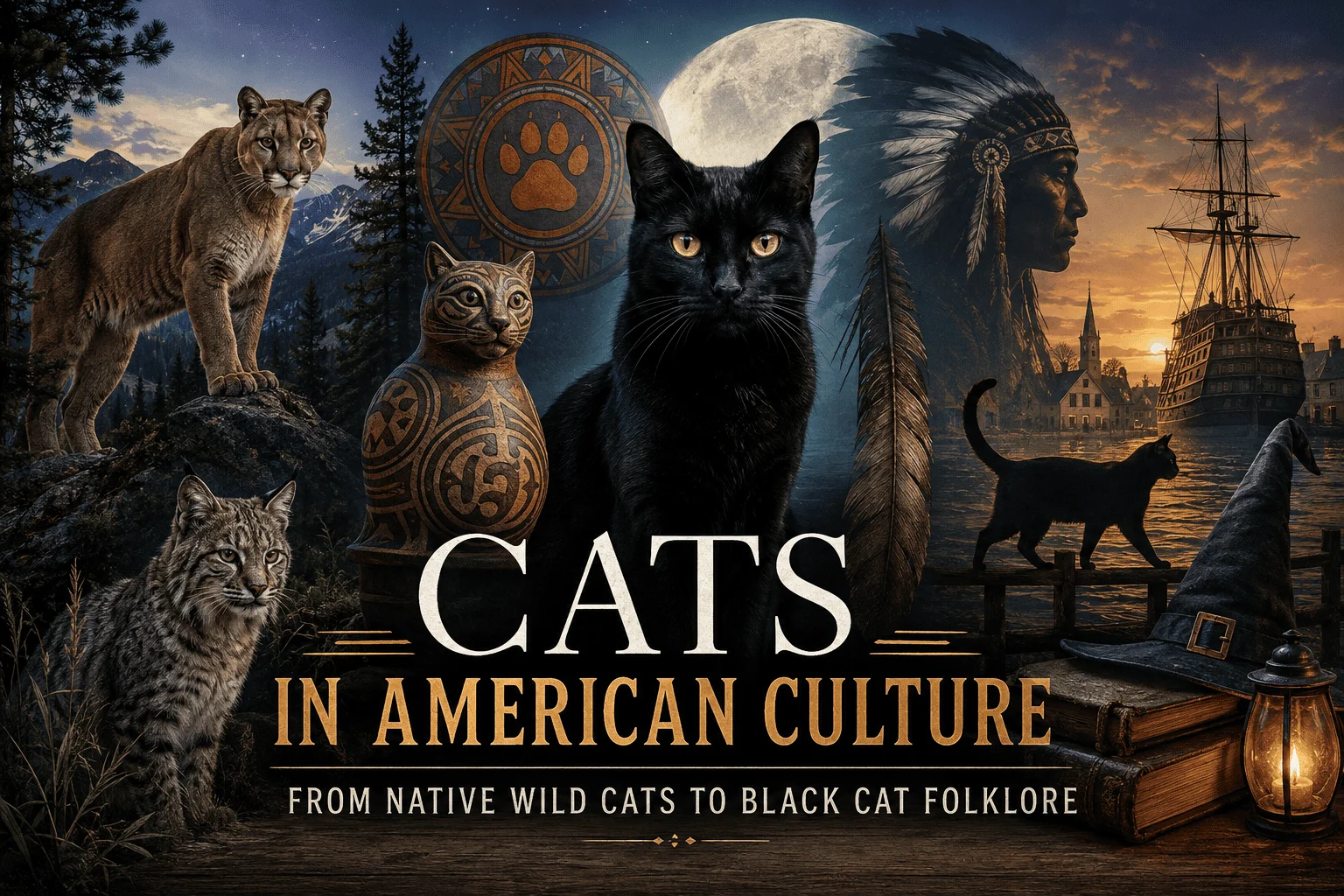
Cats have a fascinating place in American culture. However, their story did not begin with the house cats we know today.Long before domestic cats arrived in North America, the continent was already home to powerful wild felines. Mountain lions, bobcats, and lynx lived across different regions. Indigenous peoples developed diverse relationships with these animals.
Later, European settlers brought domestic cats across the Atlantic. These cats became useful around homes, farms, ships, and food stores. At the same time, European beliefs about witches, black cats, magic, and omens crossed the ocean too.Over time, these different traditions became part of American folklore.
Today, a black cat can represent mystery or Halloween. A mountain lion can represent wilderness. A house cat can represent independence, comfort, or companionship.So, how did cats become such powerful symbols in American culture? The answer is a long story involving Indigenous traditions, native wildlife, European folklore, colonial history, superstition, and modern popular culture.
📖Article Outline
- Why Cats Matter in American Culture
- The Wild Cats of North America Before Domestic Cats
- Mountain Lions and the Meaning of Wilderness
- Feline Figures in Indigenous Traditions
- Bobcats and Lynx
- Why “Native American Cat Mythology” Can Be Misleading
- When Domestic Cats Arrived in America
- Cats as Working Animals
- European Folklore and American Superstition
- Why Black Cats Became Linked to Witches
- Black Cats and Halloween
- Cats as Protectors
- Good-Luck Cats and Positive Beliefs
- Cats in Modern American Popular Culture
- What Cats Represent Today
- The Bigger Story Behind American Cat Folklore
- Frequently Asked Questions
Why Cats Matter in American Culture
Cats are unusual cultural symbols because they seem to exist between different worlds.They can live comfortably inside a home. Yet they still have strong hunting instincts. They can be affectionate, but they also value independence. Many cats are most active at dawn, dusk, or night.These qualities make cats perfect subjects for folklore.In many stories, cats represent mystery, independence, danger, luck, or hidden knowledge. Their quiet movements also make them seem almost supernatural.However, American cat folklore does not come from one single tradition.That point is especially important when discussing Indigenous peoples. North America has always been home to many different Indigenous nations. Each nation has its own history, language, environment, and cultural traditions.Therefore, there is no single “Native American belief about cats.”Instead, we need to look at specific cultures and specific animals.
The Wild Cats of North America Before Domestic Cats
Domestic cats were not native to North America. However, several wild feline species lived here long before European colonization.These included mountain lions, bobcats, and lynx.
Each species adapted to different environments. Mountain lions occupied large territories across much of the continent. Bobcats adapted to forests, deserts, mountains, and other habitats. Canada lynx became especially suited to northern forests and snowy environments.These animals were also important predators.For example, the National Park Service describes mountain lions as apex predators in some ecosystems. Their presence can influence prey populations and help maintain ecological balance.At the same time, their behavior helped create a powerful image.Mountain lions are solitary. They are quiet. They can travel long distances without being seen.People might find tracks without seeing the animal that made them. They might hear movement in the darkness without knowing what caused it.As a result, the wild cat became more than an animal. In some cultural settings, it could also become a symbol of the unknown.
Mountain Lions and the Meaning of Wilderness
The mountain lion is one of North America’s most recognizable wild cats.It has many names, including cougar, puma, panther, and catamount. Its range has also changed over time because of habitat loss and human activity.The animal’s physical strength is only part of its cultural power.Its behavior matters too.A mountain lion usually avoids people. It can move through large landscapes without being noticed. That combination of strength and secrecy makes it an ideal symbol of wild places.The National Park Service notes the elusive nature of mountain lions and records the phrase “ghost walker” in connection with the animal.Today, Americans often associate mountain lions with wilderness and conservation.That meaning also connects the modern world with older human relationships with wild animals.The mountain lion reminds people that some parts of North America remain wild. It also shows that animals can become cultural symbols without losing their ecological importance.
Feline Figures in Indigenous Traditions
Some of the most interesting feline imagery in North American history comes from Indigenous cultures.One important example is the Key Marco Cat. The Smithsonian Institution preserves this carved wooden figure, which is associated with the Calusa culture of Florida.Smithsonian records describe the object as a feline or human-feline figure. It dates broadly to the period between about A.D. 700 and 1500.This artifact is important for another reason.It shows that feline imagery existed in Indigenous North America long before European settlers brought domestic cats to the continent.Smithsonian documentation also discusses feline supernatural figures known as Underwater Panthers in Southeastern Indigenous traditions.These figures belong to a much larger cosmological system. They should not be reduced to the simple idea that Indigenous peoples “worshipped cats.”That description would be misleading.Instead, feline figures could be connected with power, transformation, the natural world, and supernatural forces.The exact meaning also depended on the culture and tradition involved.
Bobcats and Lynx
Mountain lions are not the only wild cats with a place in North American history.Bobcats are smaller, but they are highly adaptable. They can live in forests, deserts, mountains, and other environments.They also have several characteristics that make them visually distinctive. Their short tails, tufted ears, camouflage, and nocturnal habits give them an almost mysterious appearance.Canada lynx are different again.They are strongly adapted to cold northern environments. Their large paws help them move through snow, while their thick fur provides protection against low temperatures.However, we should be careful when assigning symbolic meanings to these animals.There is no universal Indigenous interpretation of the bobcat or lynx.Instead, meanings depend on the particular community, location, and tradition.
Why “Native American Cat Mythology” Can Be Misleading
Online articles sometimes use phrases such as “Native Americans believed that cats represented…”The problem is simple.There was never one single Native American culture.Indigenous North America included hundreds of distinct nations. Their traditions developed in very different environments. Therefore, a belief associated with one nation should not automatically be presented as a belief shared by all Indigenous peoples.This distinction is especially important when discussing animals.A mountain lion could have one meaning in one cultural context and another meaning elsewhere. The same applies to other wild cats.For that reason, reliable sources should identify the specific culture whenever possible.The Smithsonian provides a good example. Its collections allow researchers to connect feline imagery with particular Indigenous communities and historical contexts.This approach is both more accurate and more respectful.
When Domestic Cats Arrived in America
The story changed after European colonization.Domestic cats were introduced to North America by Europeans. These cats quickly became useful around colonial settlements.Their main job was practical.They hunted mice and rats around homes, barns, farms, food stores, and ships.That role helped cats become part of everyday life.However, the settlers did not bring only cats.
They also brought stories.European folklore already contained many beliefs about cats. Some traditions connected cats with witches, magic, omens, and supernatural creatures.These beliefs later became part of American folklore.
Cats as Working Animals
Early American cats were often working animals rather than pampered pets.A farm cat could protect food supplies by catching rodents. A barn cat could control pests. A ship’s cat could help keep rats away from stored food and cargo.In other words, cats provided a practical service.Yet their mysterious reputation remained.This created an interesting contrast.People could value a cat because it was useful while also believing stories about strange behavior, omens, or supernatural powers.That combination helped cats become deeply rooted in American culture.
European Folklore and American Superstition
Many famous American cat superstitions have European roots.The connection between cats and witchcraft developed over centuries in Europe. Black cats, in particular, became linked with supernatural beliefs.The Library of Congress explains that medieval European ideas connected black cats with the Devil. Later traditions connected cats with witches and supernatural familiars.European settlers carried these ideas across the Atlantic.Once they reached colonial America, the stories began to change.Folklore is rarely static.Stories change when people move. They also change through newspapers, books, oral storytelling, entertainment, and popular culture.Therefore, American black-cat folklore became a mixture of older European beliefs and newer American traditions.
Why Black Cats Became Linked to Witches
Black cats became one of the strongest visual symbols of witchcraft.The association did not begin in modern America.Instead, it developed through older European beliefs about witches and supernatural familiars.The Library of Congress describes the historical connection between black cats, witchcraft, and supernatural beliefs. HISTORY also traces the association back to European traditions that existed centuries before the modern Halloween image appeared.Over time, American popular culture simplified these ideas.The witch became a familiar Halloween character. The black cat became her companion.Eventually, the two symbols became almost inseparable.Yet the original history was much more complicated.
Black Cats and Halloween
Halloween helped preserve the black cat as a cultural symbol.Today, black cats commonly appear beside witches, pumpkins, ghosts, bats, and haunted houses.The Library of Congress documents the historical development of these Halloween traditions.However, modern Halloween does not simply reproduce old European beliefs.Instead, it transforms them.A black cat that once represented fear can now appear on a child’s costume. A symbol connected with witchcraft can become a cute decoration.That change shows how folklore survives.It does not always survive in its original form.Sometimes it becomes entertainment.
Cats as Protectors
Cats have also appeared in folk traditions as protective animals.Historical evidence shows that cats could occupy an unusual place in European and colonial folk beliefs.For example, HISTORY has documented discoveries of cats deliberately concealed inside buildings in Britain and colonial America. Such practices have been connected with protective folk beliefs involving witches or supernatural threats.This does not mean that every colonial household followed such customs.Instead, these discoveries show how cats could become part of protective folklore.At the same time, cats remained useful animals.They could protect food from rodents while also becoming symbols of protection in folk traditions.
Good-Luck Cats and Positive Beliefs
Black cats are often described as symbols of bad luck.However, that belief is not universal.Different cultures have developed different interpretations of black cats.HISTORY notes that black cats have also been associated with good fortune and prosperity in places such as Scotland and Japan.This is an important reminder.Animals do not naturally represent good luck or bad luck.People create those meanings.As cultures change, those meanings can change too.Even in America, the modern black cat is not always viewed negatively.Today, black cats can represent beauty, mystery, Halloween, or simply the personality of an individual pet.
Cats in Modern American Popular Culture
During the twentieth century, cats moved far beyond traditional folklore.They became major characters in cartoons, movies, television, advertising, books, and eventually the internet.
Cartoons often presented cats as clever tricksters.Movies used them as mysterious companions.Advertising turned them into recognizable symbols.Halloween kept the black cat alive as a supernatural image.Then the internet changed everything.Online, cats became a global source of humor and entertainment.The modern American cat can now represent almost anything:
- Independence
- Humor
- Mystery
- Comfort
- Beauty
- Rebellion
- Cuteness
- Internet culture
Yet some older ideas remain.People still describe cats as mysterious. Black cats still appear in Halloween decorations. Mountain lions still represent wilderness.The old symbolism has not disappeared.It has simply evolved.
What Cats Represent in America Today
Modern American culture gives cats many different meanings.For some people, a cat is simply a beloved companion.For others, cats symbolize independence because of their behavior and personality.Wild cats have another role.Mountain lions, bobcats, and lynx remind Americans that the continent still contains important wild ecosystems.Black cats have yet another role.They can represent mystery and Halloween without necessarily representing evil or bad luck.These meanings can exist at the same time.That is what makes cat symbolism so interesting.
The Bigger Story Behind American Cat Folklore
The history of cats in American culture is really a story about how humans understand animals.Before domestic cats arrived, North America already had powerful wild felines.Indigenous nations developed their own relationships with these animals. In some traditions, feline figures also appeared in art and cosmology.Later, Europeans introduced domestic cats.They also introduced stories about witches, supernatural animals, omens, and magic.Colonial communities adapted those traditions. Later, American literature, newspapers, movies, television, Halloween, advertising, and the internet changed them again.That history explains why the modern American cat can be both spooky and adorable.A black cat can appear on a Halloween poster. The same black cat can sleep on someone’s sofa.A mountain lion can be a dangerous predator. It can also become a symbol of wilderness conservation.These contradictions are not a problem.They are exactly what makes cats so powerful in folklore.Cats live close to humans, but they still retain something wild.They can be affectionate without being completely dependent. They can disappear into the darkness and return a few minutes later as if nothing happened.That balance between familiarity and mystery has kept cats inside human stories for centuries.
Perhaps that is the real secret of the American cat.
It lives somewhere between the domestic and the wild, the ordinary and the mysterious.And American folklore has always been fascinated by things that live between worlds.
❓ Frequently Asked Questions About Cats in American Culture
Were cats native to North America?
Domestic cats were not native to North America. Europeans introduced them during the colonial period. However, North America already had native wild felines such as mountain lions, bobcats, and lynx.
Did Native Americans have cat mythology?
There was no single Native American cat mythology. Indigenous nations have different cultures and traditions. Some Southeastern traditions include powerful feline figures such as Underwater Panthers. The Smithsonian provides documented examples from the Indigenous Southeast.
What is the Key Marco Cat?
The Key Marco Cat is a carved wooden feline figure associated with the ancient Calusa culture of Florida. Smithsonian records date the object broadly to between A.D. 700 and 1500.
Why are black cats associated with witches?
The association mainly developed from European beliefs about witches, the Devil, and supernatural familiars. These beliefs later crossed into colonial America.
Why are black cats associated with Halloween?
Halloween adopted older European ideas involving witches and supernatural creatures. American popular culture later turned the black cat into one of the holiday’s most recognizable symbols.
Are black cats considered unlucky everywhere?
No. Beliefs vary between cultures. In some traditions, black cats are associated with good fortune or prosperity rather than bad luck.
What did cats do in colonial America?
Domestic cats often worked as pest controllers. They hunted mice and rats around farms, homes, food stores, barns, and ships.
What does the mountain lion symbolize in America?
Today, mountain lions often symbolize wilderness, strength, independence, and conservation. Their cultural meaning has varied across different communities and periods.
Did all Indigenous peoples consider wild cats sacred?
No. That would be an inaccurate generalization. Indigenous nations have different cultural traditions. The meaning of a wild cat depends on the specific community and context.
Why are cats associated with mystery?
Cats often move quietly and remain active at night or during twilight. Their hunting behavior and independence can make them seem mysterious. Folklore has expanded these natural traits into stories about magic, luck, and supernatural powers.
References and Authentic Sources
- Smithsonian Institution — National Museum of Natural History.
Key Marco Cat and documentation relating to feline imagery and Indigenous traditions of the Southeastern United States. - National Park Service.
Information about mountain lions, their behavior, ecology, and cultural descriptions. - Library of Congress — American Folklife Center.
Historical information about Halloween traditions, black cats, witches, and American folklore. - Library of Congress — Folklife Today.
Research and discussion of American folk traditions and supernatural folklore. - HISTORY.
Historical background on black cats, superstition, witchcraft, and Halloween traditions. - HISTORY.
Research concerning concealed cats and protective folk practices in Britain and colonial America.