Cats have always seemed perfectly suited to supernatural stories. They move silently, see well in darkness, disappear without warning, and often appear to notice things that humans cannot.Japanese folklore transformed those familiar feline qualities into some of its most memorable supernatural creatures: the Bakeneko and the Nekomata.
At first glance, these two cat yōkai can seem almost identical. Both may begin as ordinary cats, but their legends quickly move into supernatural territory. They can acquire extraordinary abilities such as shapeshifting and human speech. Stories also connect them with revenge, mysterious lights, deception, and encounters with the dead.
However, Bakeneko and Nekomata are not simply two names for the same creature. Their traditions overlap, yet their histories developed in different ways. The Nekomata has especially old connections with mysterious creatures said to inhabit the mountains, while the Bakeneko became closely associated with the frightening possibility that an ordinary household cat could transform into something supernatural.
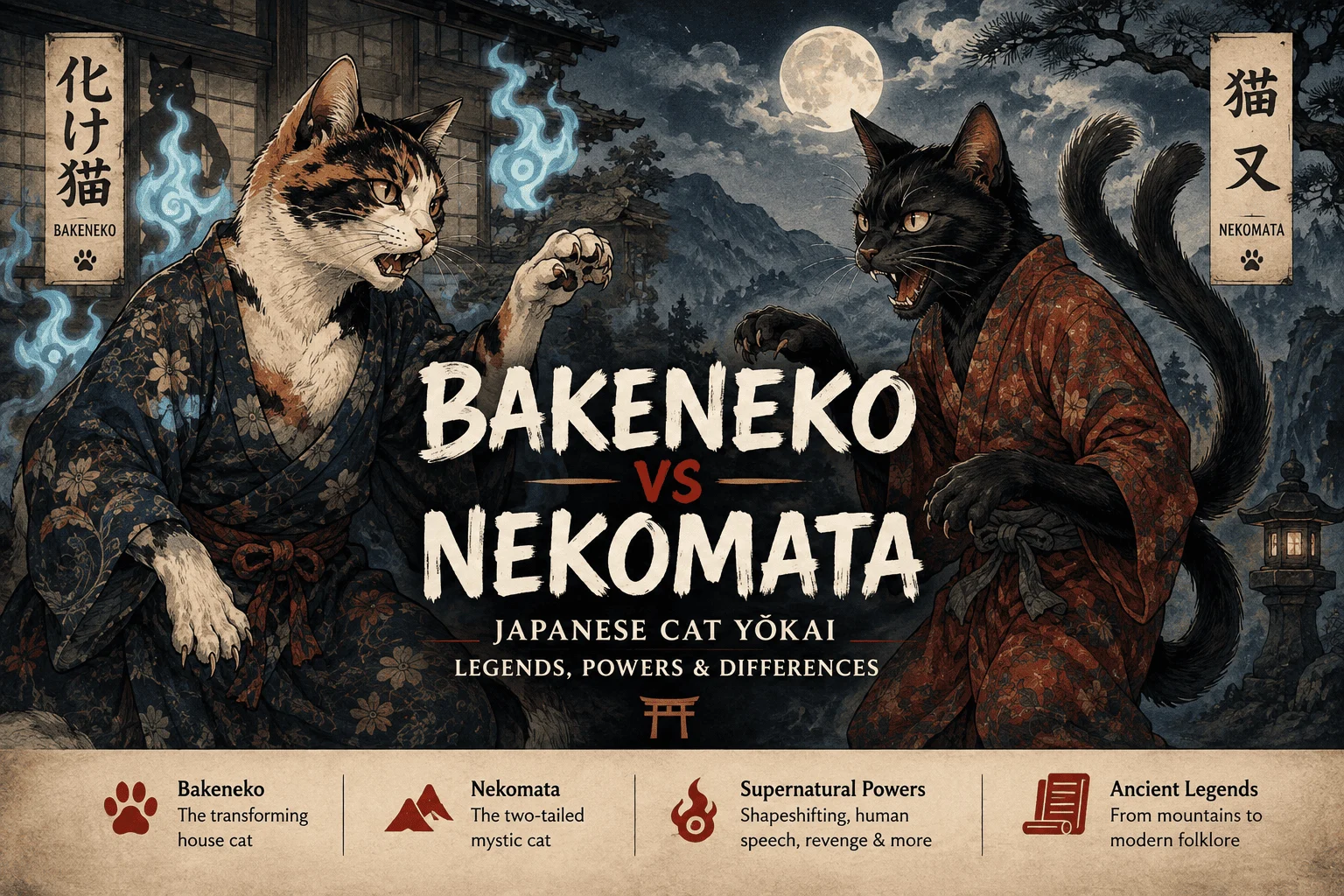
This guide explores Bakeneko vs Nekomata, their origins, powers, legends, differences, artistic representations, and lasting influence on Japanese culture.
Explore This Guide
- Bakeneko vs Nekomata: Quick Answer
- What Is a Yōkai?
- What Is a Bakeneko?
- Bakeneko Powers and Abilities
- What Is a Nekomata?
- The Older Mountain Nekomata
- The Domestic Nekomata
- Bakeneko vs Nekomata Comparison
- Why Does the Nekomata Have Two Tails?
- Why Did Cats Become Supernatural in Japanese Folklore?
- The Nabeshima Bakeneko Legend
- Bakeneko and Nekomata in Japanese Art
- Are These Legends Connected to the Japanese Bobtail?
- Bakeneko and Nekomata in Modern Culture
- What These Supernatural Cats Represent
- Frequently Asked Questions
- References and Further Reading
Bakeneko vs Nekomata: Quick Answer
A Bakeneko is generally understood as a cat that has changed or transformed and gained supernatural abilities. Depending on the tale, it may speak like a human, walk on two legs, disguise itself as a person, dance, create strange lights, or seek revenge.
A Nekomata belongs to another supernatural cat tradition. Older Japanese sources mention dangerous nekomata associated with mountains and wilderness. Later folklore increasingly described domestic cats that became supernatural after living for many years.
The most recognizable later feature of the Nekomata is its forked or divided tail.
Modern fiction sometimes treats the Nekomata as an upgraded or evolved Bakeneko. Traditional Japanese folklore is much less systematic. The two creatures overlap in many stories, but one should not automatically be described as the next stage of the other.
What Is a Yōkai?
The Japanese term yōkai refers to a broad range of strange, supernatural, mysterious, or extraordinary beings and phenomena.Translating the word simply as “demon” can create the wrong impression. Some yōkai are dangerous, but others are mischievous, humorous, tragic, protective, or simply strange.
Most importantly, yōkai do not follow a single official rulebook. Their appearances and abilities changed across different regions, historical periods, artists, writers, and storytellers.That flexibility is essential when studying Bakeneko and Nekomata. One tale may portray a supernatural cat as terrifying, while another presents a similar creature in a playful or satirical way.
For a broader look at the relationship between people and cats in Japan, see our guide to cats throughout Japan’s history.
What Is a Bakeneko?
Bakeneko is often translated as “changed cat,” “transforming cat,” or “monster cat.” The word emphasizes transformation rather than a single physical appearance.Its basic concept is simple but unsettling. A familiar house cat may live beside humans for years before crossing an invisible boundary and becoming something supernatural.Different stories give different reasons for the transformation. Some focus on old age. Others mention unusual size, a long tail, mistreatment, or simply the mysterious nature of cats themselves.A Bakeneko does not always stop looking like a cat. In many stories, it remains visibly feline while displaying impossible behavior. Other tales give it the ability to assume human form or impersonate someone familiar.This made the Bakeneko particularly effective in supernatural storytelling. A monster in a distant forest can be avoided. A creature that already sleeps inside the house is far more disturbing.
Bakeneko Powers and Abilities
The abilities of a Bakeneko vary from story to story. However, several supernatural traits appear repeatedly in Japanese folklore.
Shapeshifting
Shapeshifting is perhaps the most famous Bakeneko ability. A supernatural cat may transform into a human or imitate a specific person.That ability creates one of the most unsettling themes in Bakeneko stories: someone inside the household may no longer be who everyone believes them to be.
Human Speech
Some tales give supernatural cats the power to understand or produce human language.Cats already live closely with people while maintaining an unusually independent personality. Folklore extended that behavior into the idea that cats might understand far more than humans realize.
Walking and Dancing Like Humans
Bakeneko may stand upright or move on two legs. Japanese supernatural imagery also includes cats dancing while wearing cloth or towels over their heads.Such scenes can appear humorous at first. The same image becomes much stranger when the animal is supposed to be secretly imitating human behavior.
Strange Fire and Lamp Oil
Cats licking household lamp oil helped inspire supernatural suspicion.Before electric lighting, certain lamp oils contained animal or fish-derived ingredients that attracted cats. To reach the oil, a cat might rise onto its hind legs, creating an eerie silhouette in dim light.An ordinary feeding behavior could therefore appear frightening to someone already familiar with stories about transforming cats.
Revenge
Revenge became another major theme in Bakeneko legends.A cat that had been abused, neglected, or connected with a mistreated owner could return as a supernatural force. In these stories, the animal often remembers cruelty long after humans believe the matter has ended.Not every Bakeneko seeks revenge, but vengeance became one of the creature’s most powerful literary roles.
Connections With Spirits and Death
Some supernatural-cat traditions connect Bakeneko with funerals, spirits, corpses, or death.These themes occasionally overlap with other feline yōkai, especially the kasha. Because folklore traditions influence one another, strict boundaries between supernatural cat categories are not always possible.
What Is a Nekomata?
The Nekomata is commonly recognized today as a supernatural cat with two tails.That appearance is important, but the history of the creature is much older than the familiar two-tailed design suggests.Medieval Japanese texts already contain references to something called nekomata. Those early accounts do not simply describe an older pet cat whose tail suddenly divides.Instead, some traditions describe dangerous feline creatures living in mountains or remote areas.Over time, stories about these wild nekomata developed alongside another belief: domestic cats could eventually become supernatural after living for many years.The two traditions increasingly influenced each other, especially during later periods of Japanese folklore and popular culture.
The Older Mountain Nekomata
One of the most important differences between Bakeneko and Nekomata becomes clear when we examine medieval accounts.Some early references describe nekomata as dangerous creatures associated with mountains. These were not necessarily former household pets.Yoshida Kenkō’s medieval work Tsurezuregusa, commonly translated as Essays in Idleness, preserves an especially interesting example.Section 89 mentions rumors about creatures called nekomata living deep in the mountains and supposedly attacking humans. The same passage also refers to a belief that cats kept for a long time could eventually become nekomata.The story then becomes humorous.A man walking home at night becomes terrified because he believes a nekomata has attacked him. After the confusion ends, the supposed monster turns out to be his own dog jumping on him in the darkness.This episode tells us something important. Belief in nekomata was familiar enough to create genuine fear, but it could also become the subject of humor.It also shows that ideas about mountain nekomata and transformed domestic cats could exist side by side.
The Domestic Nekomata
Later folklore increasingly emphasized the domestic Nekomata.
An ordinary cat might live with a household for many years before crossing into the supernatural world. In later visual traditions, its tail could divide into two, immediately revealing its transformation.The domestic Nekomata shares many abilities with the Bakeneko. Stories may give it human speech, shapeshifting, strange fire, deceptive powers, or the ability to take revenge.Some traditions also strengthen its association with death, spirits, and the manipulation of corpses.Because these abilities overlap so heavily, modern readers often struggle to separate Bakeneko and Nekomata.The confusion is understandable. Japanese folklore developed through retelling rather than through a centralized classification system.
Bakeneko vs Nekomata: Key Differences
| Feature | Bakeneko | Nekomata |
|---|---|---|
| General meaning | A changed or transforming supernatural cat | A supernatural cat tradition with mountain and domestic forms |
| Historical association | Strongly linked with transformed domestic cats | Includes older medieval mountain-creature traditions |
| Typical tail | No universal special tail requirement | Two tails became its iconic later appearance |
| Shapeshifting | Common | Common in many later stories |
| Human speech | Frequently associated | Frequently associated |
| Revenge | A major theme | Also appears frequently |
| Association with death | Appears in several traditions | Often stronger in later stories |
| Always evil? | No | No |
| Is it an evolved Bakeneko? | Not applicable | Not as a universal traditional rule |
Why Does the Nekomata Have Two Tails?
The divided tail eventually became the most recognizable feature of the Nekomata.By the Edo period, artists and writers were creating increasingly recognizable visual identities for many yōkai. A supernatural cat with two tails could immediately be distinguished from an ordinary feline.The split tail also works as a visual symbol of transformation. Something familiar has crossed a boundary and become something else.Age plays an important role in many versions of the legend. A cat lives beside humans for years, watches their behavior, learns their routines, and gradually acquires powers beyond those of a normal animal.
Other stories focus on the cat’s size or unusually long tail.For this reason, claims that a cat automatically becomes a Nekomata at one exact age should be treated cautiously. Japanese folklore contains many variations rather than one universally accepted rule.
Why Did Cats Become Supernatural in Japanese Folklore?
Cats possess several natural behaviors that make them ideal subjects for supernatural stories.They live inside human homes, yet remain remarkably independent. Silent movement makes them especially mysterious after dark, while their reflective eyes can appear almost supernatural in low light. Cats are also highly active at night, sometimes staring toward things humans cannot perceive before suddenly leaping into darkness and disappearing from view.
Cats Crossed the Boundary Between Domestic and Wild
A cat can be deeply attached to a household without behaving like an obedient domestic animal.It may sleep beside a person during the day and disappear into the night hours later.That independence made cats powerful symbols of boundaries: domestic and wild, familiar and unknown, visible and invisible.
Old Cats Seemed to Accumulate Knowledge
Longevity often creates supernatural importance in folklore.An animal or object that survives for an unusually long time can appear to accumulate knowledge and power.An older cat may have watched generations of human behavior. Folklore transformed that idea into the possibility that the animal understood far more than its owners suspected.
Nighttime Behavior Encouraged Suspicion
Cats see and move exceptionally well in darkness. Their pupils change dramatically, and their eyes reflect light.In a house illuminated only by candles or oil lamps, those characteristics would have appeared even stranger than they do today.A cat standing upright to reach lamp oil could easily become the beginning of a supernatural story.
Cats Became Connected With Death and Spirits
Cats are predators with a highly developed sense of smell. Their presence around homes, sick people, food, and occasionally funerary environments helped create supernatural associations.Over time, several Japanese feline yōkai traditions developed connections with death, spirits, and corpses.
The Nabeshima Bakeneko Legend
One of Japan’s most famous supernatural-cat stories is the Nabeshima Bakeneko legend associated with Saga.Several versions exist, and their details changed through storytelling, theater, literature, and later adaptations.In one widely circulated version, a member of the Ryūzōji family dies after conflict with a Nabeshima lord. His grieving mother shares her suffering with her cat before taking her own life.The cat then licks her blood and becomes a supernatural creature driven by vengeance.After entering the Nabeshima household, the transformed cat begins tormenting its inhabitants. Some versions describe it killing or impersonating a woman. Others focus on curses, illness, deception, or direct attacks.Eventually, the supernatural cat is confronted and defeated.The tale should not be treated as a simple historical record. Its importance lies in the way political tension, revenge, family tragedy, existing cat folklore, and popular entertainment became combined into one memorable story.During the later Edo period, theatrical and literary versions helped spread the image of the revenge-seeking Bakeneko far beyond Saga.
Bakeneko and Nekomata in Japanese Art
Visual art played a major role in shaping how later generations imagined supernatural cats.During the Edo period, illustrated books and prints gave many yōkai recognizable appearances. Creatures that had once varied greatly in oral storytelling could now develop familiar visual identities.
The Two-Tailed Nekomata
Artists increasingly depicted Nekomata standing upright with two tails.That design became so influential that the divided tail now functions almost like a visual shorthand for the creature.
Dancing Supernatural Cats
Other images show cats dancing, wearing clothing, imitating human activities, or gathering together away from human observation.These scenes combine comedy with unease. The humor comes from seeing cats behave like people, while the supernatural implication suggests that humans may not truly understand the animals living beside them.
Ghostly Flames
Supernatural cats also appear alongside mysterious flames or lights.Modern anime and games frequently reuse this visual language, often giving two-tailed cats blue or ghostly fire.
Are Bakeneko and Nekomata Legends Connected to the Japanese Bobtail?
This subject needs careful treatment.Some folklore traditions expressed suspicion toward aging cats or cats with unusually long tails. Stories also exist in which shortening a cat’s tail supposedly prevented supernatural transformation.However, those beliefs do not prove that fear of Nekomata directly created the Japanese Bobtail breed.The modern Japanese Bobtail has a naturally occurring short, kinked tail and its own biological and cultural history.The safer conclusion is that cat tails acquired supernatural meanings in Japanese folklore, while the Japanese Bobtail is a real breed whose history cannot be reduced to one legend.
Bakeneko and Nekomata in Modern Culture
Japan’s supernatural cats did not disappear when older folklore traditions declined.Instead, they entered manga, anime, video games, novels, films, toys, illustrations, and modern character design.
Contemporary creators often borrow recognizable features such as two tails, ghostly flames, long life, human transformation, magical speech, or a connection with spirits.Modern stories may also portray Nekomata and Bakeneko much more sympathetically than older horror tales.A supernatural cat may now appear as a guardian, companion, comic character, magical partner, or misunderstood spirit.Creators frequently combine elements from several yōkai traditions. As a result, a modern character called a Nekomata may also display abilities historically associated with Bakeneko, kitsune, kasha, or other supernatural beings.This does not make modern representations “wrong.” Folklore has always evolved through retelling.
What These Supernatural Cats Really Represent
The lasting appeal of Bakeneko and Nekomata comes from more than their magical abilities.They transform something familiar into something uncertain.A cat can be affectionate without being obedient. It may share a home with people while maintaining habits that seem completely independent from human expectations.Japanese folklore turned that independence into possibility.Perhaps the cat understands every conversation. It may remember every act of kindness or cruelty, even when its owners assume those moments have been forgotten. The animal quietly watching from the corner can therefore become an unsettling symbol of knowledge that humans cannot fully control.Bakeneko stories often emphasize transformation, imitation, domestic fear, and revenge.Nekomata traditions add an older image of mysterious creatures beyond human settlements, followed later by the unforgettable symbol of the divided tail.Together, these supernatural cats show how folklore can transform ordinary animal behavior into a complex cultural language.They also remind us that yōkai rarely function like modern fictional species with fixed powers, statistics, and evolutionary stages.Stories change. Names overlap. Artists reinterpret earlier ideas, and new generations add their own meanings.For creatures inspired by cats, that flexibility seems especially appropriate.
Frequently Asked Questions
Bakeneko and Nekomata Origins
What is the main difference between Bakeneko and Nekomata?
Bakeneko generally refers to a transformed supernatural cat, especially in domestic settings. Nekomata has a more complex history that includes medieval stories about mountain creatures as well as later legends about aged domestic cats. The divided tail eventually became the Nekomata’s most recognizable feature.
Does a Bakeneko turn into a Nekomata?
Not according to any universal rule in traditional Japanese folklore. Modern fiction sometimes presents the Nekomata as a stronger or evolved Bakeneko, but historical traditions overlap rather than forming a clear supernatural progression.
Is the Nekomata older than the Bakeneko?
Written references to creatures called nekomata appear in medieval Japanese sources. Bakeneko traditions also developed over a long period, but the Nekomata has particularly important early written evidence involving mountain creatures and beliefs about long-lived domestic cats.
Transformation, Tails, and Supernatural Powers
Why does a Nekomata have two tails?
The divided tail became an iconic visual feature in later Japanese folklore and art. It helped artists distinguish the supernatural Nekomata from an ordinary cat and symbolized the animal’s transformation.
How old does a cat have to be to become a Bakeneko or Nekomata?
There is no universally accepted age. Different stories describe different conditions, while many simply refer to an old or unusually long-lived cat. Exact ages mentioned online usually represent particular folklore variants rather than a single traditional rule.
Did Japanese people cut cats’ tails because they feared Nekomata?
Some folklore traditions include the belief that shortening a cat’s tail could prevent supernatural transformation. However, this does not prove that Nekomata legends created naturally short-tailed Japanese cats or directly caused the development of the Japanese Bobtail breed.
Are all Bakeneko evil?
No. Famous stories often portray Bakeneko as dangerous or vengeful, but supernatural-cat traditions vary widely. Depending on the tale, a Bakeneko may appear frightening, tragic, mischievous, humorous, or morally ambiguous.
Are all Nekomata evil?
No universal rule describes every Nekomata as evil. Older stories can portray them as dangerous, and later tales sometimes connect them with revenge or death. Modern interpretations frequently present Nekomata in much friendlier roles.
Bakeneko and Nekomata Today
Are Bakeneko and Nekomata still popular in Japan?
Yes. Their imagery continues to influence manga, anime, video games, films, books, character design, and contemporary yōkai culture. Modern creators often reinterpret older folklore instead of reproducing it exactly.
Why are Nekomata so common in anime and video games?
The two-tailed design gives the Nekomata an instantly recognizable appearance. Its associations with magic, spirits, transformation, and cats also make it highly adaptable for fantasy characters.
Can a modern fictional Nekomata have powers that do not appear in traditional folklore?
Absolutely. Modern creators frequently combine supernatural traditions or invent new abilities. A character inspired by Nekomata folklore does not need to reproduce historical legends exactly.
References and Further Reading
- Foster, Michael Dylan. The Book of Yōkai: Mysterious Creatures of Japanese Folklore, Expanded Second Edition. University of California Press, 2024.
- Davisson, Zack. Kaibyō: The Supernatural Cats of Japan. Chin Music Press, 2017.
- Yoshida Kenkō. Tsurezuregusa (Essays in Idleness), particularly Section 89. Japanese Text Initiative, University of Virginia Library.
- Toriyama Sekien. Gazu Hyakki Yagyō. 1776. One of the major illustrated collections that shaped later visual representations of Japanese yōkai.
- Japan Search. Digital collections related to Japanese history, folklore, literature, visual culture, and historical representations of cats.
- Smithsonian Libraries and Archives. Bibliographic and collection information related to Kaibyō: The Supernatural Cats of Japan.
Japanese folklore changed across historical periods, regions, artists, and storytellers. This article distinguishes recurring traditions from universal rules wherever possible.