
Table of Contents
- Cats in Swedish Life: A Relationship Across Generations
- Cats and Norse Mythology: The Story of Freyja
- From Viking-Age Settlements to Modern Swedish Homes
- Modern Cat Culture and Responsible Ownership in Sweden
- Understanding Swedish Cat Laws and Registration
- The Risks Facing Outdoor Cats in Sweden
- Catios, Enclosed Gardens, and Safer Outdoor Adventures
- Winter Care for Outdoor Cats in Sweden
- Outdoor Cats and Swedish Wildlife
- Building a Responsible Outdoor Routine
- Giving Swedish Cats the Best of Both Worlds
- Frequently Asked Questions
Cats in Swedish Life: A Relationship Across Generations
Cats occupy a familiar place in Swedish life. They share homes with families, keep company with people living alone, and bring curiosity and movement into everyday routines. In towns and cities, a cat might spend its day watching birds through an apartment window. In rural areas, another might enjoy a garden, explore a sheltered yard, or investigate the surroundings of a country house.
Although these experiences differ, they share an important theme: cats depend on people to provide appropriate care, even when they appear independent.
Sweden offers an especially interesting setting for exploring this relationship. Its landscapes range from densely populated urban areas to forests, farmland, lakes, and remote settlements. The seasons also change dramatically, bringing long summer evenings, autumn rain, winter darkness, and periods of snow and freezing temperatures.
For cat owners, these conditions raise practical questions. Should a cat be allowed to roam freely? Is a secure outdoor enclosure a better choice? How can an owner provide stimulation without exposing a pet to unnecessary danger?
To understand modern outdoor cat life in Sweden, it helps to begin with the country’s historical and cultural relationship with cats.
Why Cats Deserve More Than a Romantic Story
People often celebrate cats for their independence, agility, and ability to adapt to different environments. Yet independence does not mean that every cat can safely manage every outdoor situation.
A confident cat may cross a road without hesitation, investigate an unfamiliar animal, or climb into a place from which it cannot easily escape. A timid cat may become frightened by traffic, construction noise, or an unexpected encounter with a dog.
Responsible ownership means recognizing these individual differences instead of assuming that all cats benefit from unrestricted outdoor access.
The goal is not to remove every opportunity for exploration, but to make exploration as safe and enriching as reasonably possible.
Cats and Norse Mythology: The Story of Freyja

Cats have a memorable place in Norse mythology, particularly through their association with Freyja, a goddess connected with love, fertility, beauty, magic, and war.
In the stories preserved in Norse tradition, Freyja travels in a chariot drawn by two cats. The Swedish History Museum describes this detail in its account of the goddess and documents an amber cat figurine dating to the Viking Age. The museum’s account offers a fascinating connection between the modern image of the Nordic cat and the symbolic world of the past.
Read more in the Swedish History Museum’s article on Freyja, the goddess of fertility and war.
What Did Freyja’s Cats Represent?
The image of Freyja traveling with two powerful cats is one of the most recognizable feline associations in Norse mythology. It creates a striking picture of cats as companions to a powerful supernatural figure. Their presence in the story also gives modern readers a memorable way to connect cats with the mythology of the Nordic world.
However, the surviving evidence does not establish one universally accepted interpretation of what the cats symbolized to every Norse community. The myth does not prove that all Viking-Age Scandinavians regarded cats as sacred animals. Beliefs and customs varied, and much of what is known about Norse religion comes from archaeological finds and written sources preserved under particular historical circumstances.
The Swedish History Museum provides additional context in its overview of Norse religion during the Viking Age.
A Real Viking-Age Cat Figurine
The connection between cats and Norse mythology is not limited to modern illustrations. The Swedish History Museum documents an amber figurine depicting a seated cat. The object dates to approximately AD 800–1100 and was found at Birka, an important Viking-Age settlement on the island of Björkö in present-day Sweden.
The figurine provides an archaeological link between cats and the material culture of Viking-Age Scandinavia. Its association with Freyja is part of the museum’s interpretation of the object’s historical context.
It is important, however, to distinguish the physical object from the mythology associated with it. The figurine is an archaeological artefact; the claim that Freyja’s chariot was drawn by cats belongs to Norse tradition. Explore the museum’s Viking-Age cat figurine record.
Mythology and Historical Reality Are Not the Same
The story of Freyja’s cats is fascinating, but the everyday lives of cats in Viking-Age Scandinavia were more complicated than mythology alone suggests.
A scholarly study published in Current Swedish Archaeology examined archaeological and literary evidence concerning domestic cats in Viking-Age Scandinavia. It discusses varied roles, including the use of cat fur and the presence of cats in some burial contexts. This research cautions against assuming that cats always held a sacred or exclusively companion-animal status.
Read The Warrior and the Cat: A Re-Evaluation of the Roles of Domestic Cats in Viking Age Scandinavia for a more nuanced picture.
For modern readers, this distinction matters. Cats have lived alongside people in different circumstances, and their roles have changed over time. Mythology preserves one part of that relationship, while archaeology helps reveal others.
From Viking-Age Settlements to Modern Swedish Homes
Cats were useful in settlements where stored food attracted rodents. Their hunting behavior could help control mice and other small animals around buildings, storage areas, and farms.
Over time, cats became established in a range of human environments. They could live around agricultural properties, settlements, and towns, where their roles depended on the needs and circumstances of the people around them.
Historical evidence also shows that people did not always treat cats in the same way. People used cat fur, archaeologists have found cat remains in different contexts, and cats’ relationships with humans varied across time and place.
It would therefore be misleading to describe the entire history of cats in Sweden as a simple progression from sacred animals to beloved pets. The reality was more diverse.
From Working Animals to Family Companions
In modern Sweden, many cats live primarily as companions. Their daily routines may include sleeping near family members, playing with toys, watching wildlife from windows, and exploring carefully managed outdoor spaces.
Other cats live in rural environments where they may have access to larger areas, barns, or gardens. Even there, their needs for food, water, shelter, veterinary attention, and human supervision remain important.
The idea that a cat can simply look after itself because it has outdoor access is unreliable. A cat may hunt successfully and still become injured, ill, trapped, or exposed to dangerous weather.
Outdoor freedom does not remove an owner’s responsibility. This is particularly relevant in Sweden, where seasonal changes can affect the availability of water, the condition of outdoor shelter, and the safety of familiar routes.
Modern Cat Culture and Responsible Ownership in Sweden
There is no single way to describe how all Swedish people relate to cats. Household circumstances, individual preferences, the surrounding environment, and the needs of each animal influence how people choose to care for their pets.
Nevertheless, responsible cat ownership provides a useful framework for understanding outdoor cat life in Sweden.
For some households, this means keeping a cat indoors and creating an environment rich in climbing opportunities, play, hiding places, and window views. For others, it means allowing supervised outdoor access, using a harness, or building an enclosed garden space.
These approaches can all support feline welfare when they are appropriate for the individual cat and its environment.
Urban Cats and Rural Cats Face Different Challenges
A cat living in a Swedish city may encounter busy roads, pedestrians, other pets, construction sites, and limited green space. Even a familiar neighbourhood can change quickly because of traffic or building work.
A rural cat may have more room to explore, but larger outdoor areas introduce other concerns. These can include wildlife, agricultural machinery, outbuildings, unfamiliar dogs, and long distances between home and veterinary services.
Neither environment is automatically safer in every respect. Owners should assess the actual conditions around their homes rather than assume that a quiet rural setting or a densely populated neighborhood determines the best outdoor arrangement.
Indoor Enrichment Still Matters
Keeping a cat indoors does not mean that the animal must live a dull or inactive life. Climbing structures, scratching posts, interactive toys, food puzzles, hiding places, and regular play sessions can provide opportunities for exercise and mental stimulation.
A secure window perch can allow a cat to watch outdoor activity, while rotating toys and introducing new games can help prevent boredom.
If a cat is accustomed to outdoor access, introduce changes to its routine gradually. The aim is to provide meaningful alternatives rather than simply removing familiar activities without replacement.
The most suitable arrangement depends on the cat’s temperament, health, history, and the safety of the surrounding environment.
Understanding Swedish Cat Laws and Registration
Sweden has specific legal requirements concerning cat identification, registration, supervision, and welfare. Anyone keeping a cat should understand the relevant obligations rather than relying on informal advice or assumptions about customary practices.
Cats Must Be Identified and Registered
According to the Swedish Board of Agriculture, cats generally must be permanently identified and registered with the authority’s cat register, subject to the exemptions specified by the authority.
The requirement has applied since 2023. Owners must identify and register cats before they reach four months of age. If someone acquires a cat older than three months, the new owner must ensure that it is identified and register themselves within the applicable four-week period.
The requirement applies to both indoor and outdoor cats, subject to specified exemptions. Check the latest rules, identification methods, registration procedures, and exceptions in the Swedish Board of Agriculture’s cat registration guidance.
Why Registration Matters for Outdoor Cats
Identification and registration are especially useful when a cat spends time outside. A cat that wanders farther than expected may be found by a neighbor, a member of the public, or an animal welfare organization. If its identification details are correct and its registered ownership information is current, there is a clearer route to reuniting the animal with its owner.
Registration does not guarantee that every missing cat will be recovered. It does, however, provide an important identification mechanism. Owners should ensure that their contact information remains current and that the cat’s identification can be read correctly.
A collar with an appropriate identification tag may provide an additional way for someone to contact the owner, but collars should be selected carefully and should not replace legally required identification.
Owners Must Provide Appropriate Supervision and Care
Swedish law also establishes responsibilities for the supervision and care of cats. The statute concerning the supervision of dogs and cats requires owners to provide the supervision and care necessary, taking the animal’s nature and other circumstances into account, to prevent injury or significant nuisance.
The legal text is available through the Swedish Parliament’s official legislation database: Act on the Supervision of Dogs and Cats.
This principle is important for outdoor ownership. A cat’s ability to move independently does not mean that an owner can ignore its welfare or the effects of its behavior on its surroundings. The exact obligations can depend on the circumstances, so owners should consult current legislation and relevant authorities when they need to resolve a specific legal question.
Daily Checks Are Part of Responsible Care
The Swedish Board of Agriculture advises owners to check cats at least twice daily. Cats that are newborn, ill, injured, pregnant near delivery, or behaving abnormally may require more frequent attention.
Its guidance also stresses that outdoor cats and barn cats continue to depend on human care. Read the authority’s guide, How to Care for Your Cat.
For an outdoor cat, regular checks can help an owner notice changes in appetite, mobility, behavior, coat condition, or general health. A predictable feeding routine can also help establish when a cat normally returns home. If a cat suddenly fails to appear at its usual time, the owner has an earlier opportunity to investigate.
The Risks Facing Outdoor Cats in Sweden
Outdoor access offers opportunities for movement, exploration, and sensory stimulation. However, it also exposes cats to hazards that are difficult to control once an animal is roaming freely.
Understanding these risks helps owners decide whether unrestricted access, supervised outings, or an enclosed space is most appropriate.
Traffic and Road Accidents
Road traffic is a major consideration for outdoor cats, particularly in urban and suburban environments. Cats may cross roads while following familiar routes, chasing prey, or moving away from a sudden disturbance. Drivers may have little time to react, especially in poor visibility or on roads where vehicles travel quickly.
Young cats and animals unfamiliar with their surroundings may be particularly unpredictable. Owners cannot make road crossings completely safe. Where traffic is a concern, a secure garden enclosure or supervised outdoor activity can reduce exposure.
Getting Lost or Trapped
A cat may become disoriented after being frightened, chased, or transported to an unfamiliar location. It may also enter a garage, shed, storage building, or other enclosed area and become trapped when a door is closed.
These risks are not limited to rural areas. Microchip identification and registration help establish ownership if a cat is found, but they do not prevent it from going missing in the first place. Owners should pay attention to changes in neighborhood conditions and provide familiar routes back into the house whenever possible.
Encounters With Other Animals
Outdoor cats may encounter unfamiliar cats, dogs, and wildlife. Some encounters lead to territorial disputes or injuries. Others may expose cats to parasites or infectious diseases.
The risk depends on local animal populations, the cat’s vaccination and parasite-prevention program, and the circumstances of its outdoor access. Owners should discuss appropriate preventive veterinary care with a veterinarian familiar with the cat’s age, health, and lifestyle.
Seasonal Hazards
Swedish weather can change rapidly, particularly during autumn and winter. Rain, wind, freezing temperatures, snow, and reduced daylight may make outdoor exploration more difficult. Wet fur, a lack of shelter, or an inability to return indoors can increase the danger.
Cats differ in their tolerance of cold. Age, health, body condition, coat characteristics, and acclimatization can all affect how an individual animal responds. It is unwise to assume that a cat will be safe outside simply because it has a thick coat or has previously tolerated cold weather.
Catios, Enclosed Gardens, and Safer Outdoor Adventures
A catio is an enclosed outdoor space designed to allow cats to experience fresh air and outdoor stimulation while limiting their ability to roam freely. For many households, a catio provides a practical compromise between indoor living and unrestricted outdoor access.
Owners can attach a catio to a house, build one around a balcony, incorporate it into a garden, or create a freestanding enclosure.
What Makes a Good Catio?
A useful catio should provide enough space for the cat to move, stretch, climb, rest, and explore. The design should consider:
- Secure walls and a roof or other effective protection against escape.
- Materials that can withstand local weather.
- Stable construction that cannot easily tip or collapse.
- Shade during warm or sunny periods.
- Dry resting places protected from wind and rain.
- Elevated platforms and climbing opportunities.
- Easy access for cleaning, inspection, and maintenance.
- A secure entrance that prevents accidental escapes.
The design must also reflect the individual cat’s abilities. A highly athletic cat may climb or jump more effectively than an older or less active animal. Owners should inspect the enclosure regularly for loose panels, damaged mesh, gaps, and signs of wear.
Creating a Stimulating Outdoor Space
An enclosure becomes more valuable when it provides opportunities for natural feline behaviors. Different platform heights encourage climbing. Stable scratching surfaces allow cats to maintain their claws and stretch. Sheltered resting areas give them a choice between watching their surroundings and withdrawing to a quiet place.
Some cats enjoy watching birds and insects, while others prefer investigating plants, scents, and changes in the weather. Any plants placed in the enclosure should be checked for feline toxicity. Avoid pesticides, herbicides, and other substances that could harm the animal.
A catio should not be treated as a substitute for all interaction. Cats still need regular attention, play, appropriate feeding, and veterinary care.
Harness Walks and Supervised Outdoor Time
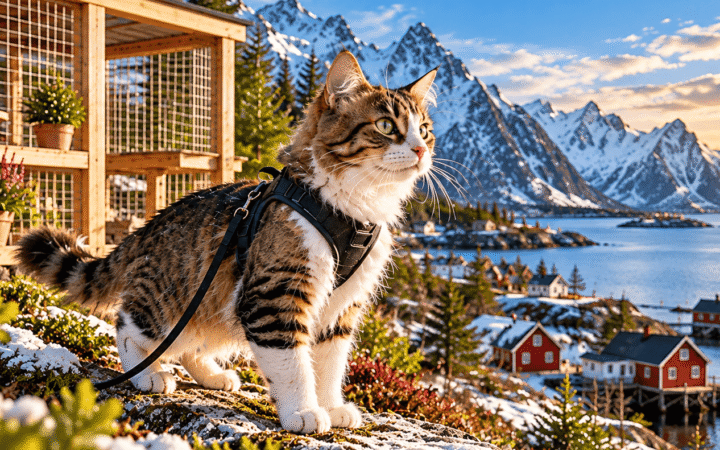
Some cats can learn to use a properly fitted harness and lead. This approach may suit confident, curious cats that tolerate the equipment and enjoy exploring with their owner. Other cats find the experience stressful and may be better served by a secure enclosure or indoor enrichment.
Introduce harness training gradually in a quiet environment. The cat should be able to move naturally without pressure or discomfort, and the owner should never force an unwilling animal into an outdoor walk.
Supervised access is most effective when the surroundings are carefully selected and the cat can be brought indoors promptly if it becomes frightened or the weather deteriorates.
Winter Care for Outdoor Cats in Sweden
Winter is one of the most important considerations for anyone caring for a cat in Sweden. Conditions differ considerably across the country. Southern coastal areas may experience milder, wetter weather, while northern regions can face prolonged cold, snow, and much longer periods of darkness.
Even within one region, conditions can change from day to day. Owners should therefore base a winter-care plan on the actual weather, the cat’s health, and its access to a warm and secure indoor environment.
Provide a Dry, Insulated Shelter
Cats that spend time outdoors should be able to reach a suitable place protected from wind, rain, and snow. A shelter should remain dry, be stable, and allow the cat to enter and leave without difficulty. It should provide enough room for the animal to rest naturally without creating excessive empty space that is difficult to keep warm.
When owners use outdoor shelters, they should inspect them regularly for dampness, damage, and accumulated snow. However, an outdoor shelter is not equivalent to a warm indoor environment. During severe weather, bringing the cat indoors is generally the safer option.
Cats that are young, older, ill, injured, or otherwise vulnerable may need additional protection.
Prevent Water From Freezing
Access to fresh water remains essential during winter. Outdoor temperatures may cause drinking water to freeze, leaving a cat without a reliable source.
Owners should check water frequently, replace frozen water promptly, and use a suitable sheltered location to reduce exposure to the elements. Water containers should be stable, clean, and easy to reach.
Adjust food and water routines to the cat’s needs instead of assuming that an outdoor animal will find everything it requires.
Know When the Cat Should Stay Indoors
There is no single temperature that defines safety for every cat. Cold tolerance varies with the animal’s condition, coat, age, health, acclimatisation, and access to shelter. Wind, moisture, and the duration of exposure also matter.
For this reason, owners should avoid relying on a universal temperature threshold. When weather conditions become severe, keeping the cat indoors is the prudent choice. Cats should also have the opportunity to return indoors rather than being left outside for extended periods without access to shelter.
Warning signs such as persistent shivering, weakness, unusual lethargy, poor coordination, or apparent distress require prompt attention. Suspected hypothermia or frostbite warrants urgent veterinary advice.
Adjust Outdoor Time to the Season
During darker months, visibility can be reduced for both cats and drivers. Reflective identification accessories may improve visibility, but they do not eliminate the risk of road accidents. A secure outdoor enclosure remains a more controlled option near busy roads.
Snow and ice can also obscure familiar routes and conceal hazards. Owners should monitor their cat’s behavior and adjust routines when weather conditions change. A cat that normally enjoys long outdoor periods may prefer shorter, supervised outings during cold or wet weather.
The key is flexibility. A safe routine in mild autumn conditions may no longer be suitable during a freezing winter spell.
Outdoor Cats and Swedish Wildlife
Sweden’s natural landscapes are part of what makes outdoor life attractive to people and their pets. Forests, gardens, meadows, and residential green spaces provide many opportunities for exploration. However, these environments are also home to wildlife.
Cats are predators, and their hunting behavior can affect birds and small mammals. The extent of the impact depends on factors such as the number of cats, their access to natural habitats, and the species present in a particular area.
Responsible outdoor ownership should therefore consider both feline welfare and the surrounding ecosystem.
Reduce Opportunities for Hunting
Secure outdoor enclosures can allow cats to experience fresh air and natural sights without giving them unrestricted access to wildlife. Owners who permit free roaming can reduce some risks by supervising outdoor time and avoiding access to sensitive areas where vulnerable wildlife may be present.
Play that imitates hunting behavior can also provide indoor stimulation. Wand toys, moving toys, and food puzzles encourage activity without requiring the cat to catch wild animals.
No single measure eliminates every ecological impact, but combining several approaches can reduce opportunities for unwanted hunting.
Be Particularly Careful During Wildlife Breeding Seasons
Spring and summer bring increased activity among many wild animals, including nesting birds and young mammals. Sweden’s Environmental Protection Agency provides guidance on young wild animals and responsible behavior around wildlife. See the Swedish Environmental Protection Agency’s guidance on young wild animals.
This is a useful reminder that responsible ownership involves more than preventing harm to the cat itself. Keeping a cat indoors at certain times, supervising outings, or using an enclosed garden can help reduce encounters with vulnerable wildlife.
Balance Exploration With Environmental Responsibility
The objective is not to suggest that every outdoor cat has the same effect on every ecosystem. Local circumstances vary, and the presence of cats alone does not explain every change in wildlife populations.
Instead, owners can make practical choices that acknowledge the hunting behavior of domestic cats and the needs of the animals sharing their surroundings. For many households, a secure outdoor enclosure offers a useful way to provide stimulation while limiting uncontrolled hunting.
Building a Responsible Outdoor Routine
A reliable routine can make outdoor access more predictable for both the cat and its owner. The most suitable routine depends on the cat’s temperament, the surrounding environment, and the owner’s ability to supervise and respond to changing conditions.
Before Allowing Outdoor Access
Consider the following checklist:
- Identification: Make sure the cat meets the applicable identification and registration requirements.
- Veterinary care: Discuss vaccinations, parasite prevention, and other preventive care with a veterinarian.
- Home access: Ensure the cat has a reliable way to return to a secure indoor environment.
- Traffic: Assess nearby roads, driveways, and other vehicle hazards.
- Wildlife: Consider nearby habitats and the presence of vulnerable animals.
- Weather: Check whether conditions are appropriate for the planned duration outdoors.
- Shelter: Provide a dry, protected resting place where necessary.
- Routine: Establish regular feeding and checking times.
- Emergency plan: Know whom to contact if the cat is injured, missing, or unwell.
This checklist does not guarantee safety, but it helps owners identify preventable problems before they arise.
Watch for Changes in Behavior
A cat’s usual behavior provides a useful reference point. Changes such as reluctance to go outdoors, repeated attempts to hide, unusual aggression, reduced appetite, or altered movement may indicate discomfort, stress, or illness.
Similarly, a cat that suddenly remains outside longer than usual or fails to return at its normal time may require attention. Owners should not assume that a cat’s independence means it will always signal clearly when something is wrong.
When a behavioral change is persistent, severe, or accompanied by physical symptoms, veterinary advice is appropriate.
Reassess the Arrangement as the Cat Ages
An outdoor routine that suited a young adult cat may become unsuitable later in life. Older cats may develop mobility problems, reduced sensory abilities, or health conditions that make outdoor exploration more challenging. Some may also become less tolerant of cold or stressful encounters.
Owners should reassess the environment as the animal’s needs change. A cat that previously roamed freely may benefit from supervised outings or a secure enclosure in later life. Such a change can preserve opportunities for stimulation while reducing avoidable exposure to danger.
Giving Swedish Cats the Best of Both Worlds
Sweden’s relationship with cats connects a fascinating historical past with the practical realities of modern animal care. In Norse mythology, cats appear in the story of Freyja, while archaeological evidence from Viking-Age settlements provides a more complex picture of their historical roles. Today, cats live in many different Swedish environments, from city apartments to rural homes surrounded by forests and fields.
Yet the central question for owners remains practical: how can a cat enjoy stimulation, movement, and outdoor experiences without facing unnecessary danger?
The answer depends on the individual animal and its surroundings. For some cats, a secure catio or enclosed garden may offer an excellent balance. Others may enjoy supervised harness walks, while indoor cats can benefit from climbing structures, play, and environmental enrichment.
Whatever arrangement an owner chooses, identification, regular care, suitable shelter, and attention to changing weather remain essential.
A responsible approach to outdoor cat life is not simply about allowing freedom or restricting it. It is about understanding the cat’s needs, recognizing the environment’s risks, and making thoughtful decisions that protect both the animal and the wildlife around it.
Frequently Asked Questions
Swedish Cat Laws and History
Can cats roam freely outdoors in Sweden?
Outdoor access is possible, but cat owners remain responsible for appropriate supervision, care, identification, and registration. Whether free roaming is suitable depends on local hazards, the cat’s needs, and the applicable rules. Check current Swedish guidance before making decisions about outdoor access.
Do cats need to be registered in Sweden?
Generally, yes. Sweden requires cats to be permanently identified and registered with the Swedish Board of Agriculture, subject to specified exemptions. Kittens must normally be identified and registered before four months of age. Consult the authority’s current guidance for details.
Who was Freyja in Norse mythology?
Freyja was a Norse goddess associated with love, fertility, beauty, magic, and war. In Norse tradition, she travelled in a chariot drawn by two cats. The Swedish History Museum documents this association in its account of the goddess.
Outdoor Safety, Enclosures, and Winter Care
Is it safe for cats to stay outside during a Swedish winter?
Safety depends on the weather, the cat’s health, age, coat, and access to shelter. Freezing temperatures, wind, moisture, and prolonged exposure can create serious risks. Cats should have access to a warm indoor environment, and severe weather is a reason to keep them inside.
What is a catio, and is it suitable for Swedish homes?
A catio is a secure outdoor enclosure that allows a cat to experience fresh air and outdoor stimulation while limiting the opportunity to roam freely. It can be adapted to gardens, balconies, or house extensions. Its construction should account for local weather, secure access, and the cat’s individual needs.
How can I protect my outdoor cat from traffic?
Assess nearby roads and vehicle movement before allowing outdoor access. Supervised outings and secure enclosures can reduce exposure to traffic. Identification is also important in case the cat goes missing, but it cannot prevent road accidents.
Wildlife, Daily Checks, and Indoor Alternatives
Do outdoor cats affect Swedish wildlife?
Cats are predators and may catch birds and small mammals. The effect varies with local conditions and the animals present. Supervised outings and secure outdoor enclosures can reduce opportunities for hunting, particularly in areas where vulnerable wildlife is present.
How often should a cat in Sweden be checked?
The Swedish Board of Agriculture advises owners to check cats at least twice daily. Newborn, ill, injured, pregnant cats near delivery, and cats behaving abnormally may require more frequent attention.
Can an indoor cat enjoy outdoor experiences safely?
Yes. A secure catio, enclosed garden, or carefully introduced harness and lead can provide outdoor stimulation. The approach should suit the cat’s temperament and physical abilities, and owners should never force a cat into an experience that causes significant distress.
Should I change my cat’s outdoor routine during winter?
Yes, when conditions warrant it. Shorter supervised outings, reliable indoor access, dry shelter, and regular checks can improve safety. During severe weather, keeping the cat indoors is the safer choice.
Sources and Further Reading
- Swedish History Museum: Freyja, Goddess of Fertility and War
- Swedish History Museum: Norse Religion in the Viking Age
- Swedish History Museum: Viking-Age Cat Figurine
- Current Swedish Archaeology: The Warrior and the Cat
- Swedish Board of Agriculture: Identification and Registration of Cats
- Swedish Board of Agriculture: How to Care for Your Cat
- Swedish Parliament: Act on the Supervision of Dogs and Cats
- Swedish Environmental Protection Agency: Guidance on Young Wild Animals