Click to Preview the Article Outline
- Maine Coon: The Friendly Gentle Giant
- Ragdoll: The Calm and Affectionate Companion
- Bengal: The Athletic House Leopard
- British Shorthair: The Calm Independent Companion
- Direct Breed Comparison
- Which Cat Breed Fits Your Lifestyle?
- Living With These Breeds in Everyday Life
- Breed Is Only Part of the Cat
- Use MeowKats Tools Before You Decide
- Finding the Right Match
- Professional Sources & Further Reading
- Frequently Asked Questions
Choosing a cat is about much more than falling in love with a beautiful face.
Cat breeds can differ significantly in size, energy level, grooming needs, sociability, and independence. A cat that thrives in a busy family home may not suit someone looking for a calm apartment companion.
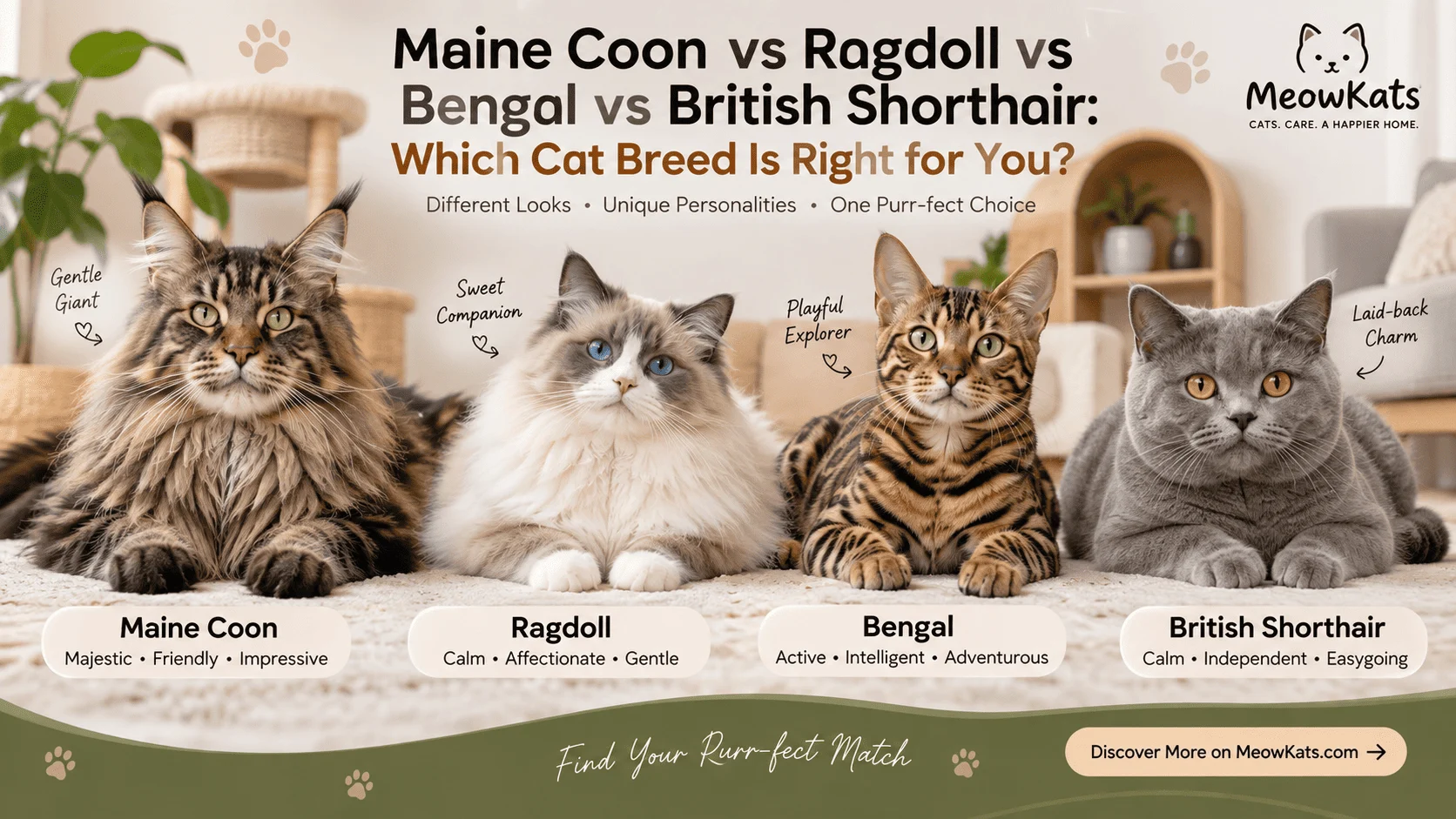
This guide compares four popular and distinctive breeds: the Maine Coon, Ragdoll, Bengal, and British Shorthair.
The Maine Coon combines impressive size with a friendly personality. The Ragdoll is famous for its calm and affectionate nature. The Bengal brings athletic energy and striking wild-looking markings. Meanwhile, the British Shorthair offers quieter and more independent companionship.
There is no universally “best” cat breed. A better question is: Which breed fits your lifestyle, home, and expectations?
Comparing their temperament, size, grooming needs, activity levels, and social behavior can help you make a more informed choice.
Maine Coon: The Friendly Gentle Giant
The Maine Coon is one of the most recognizable large domestic cat breeds.
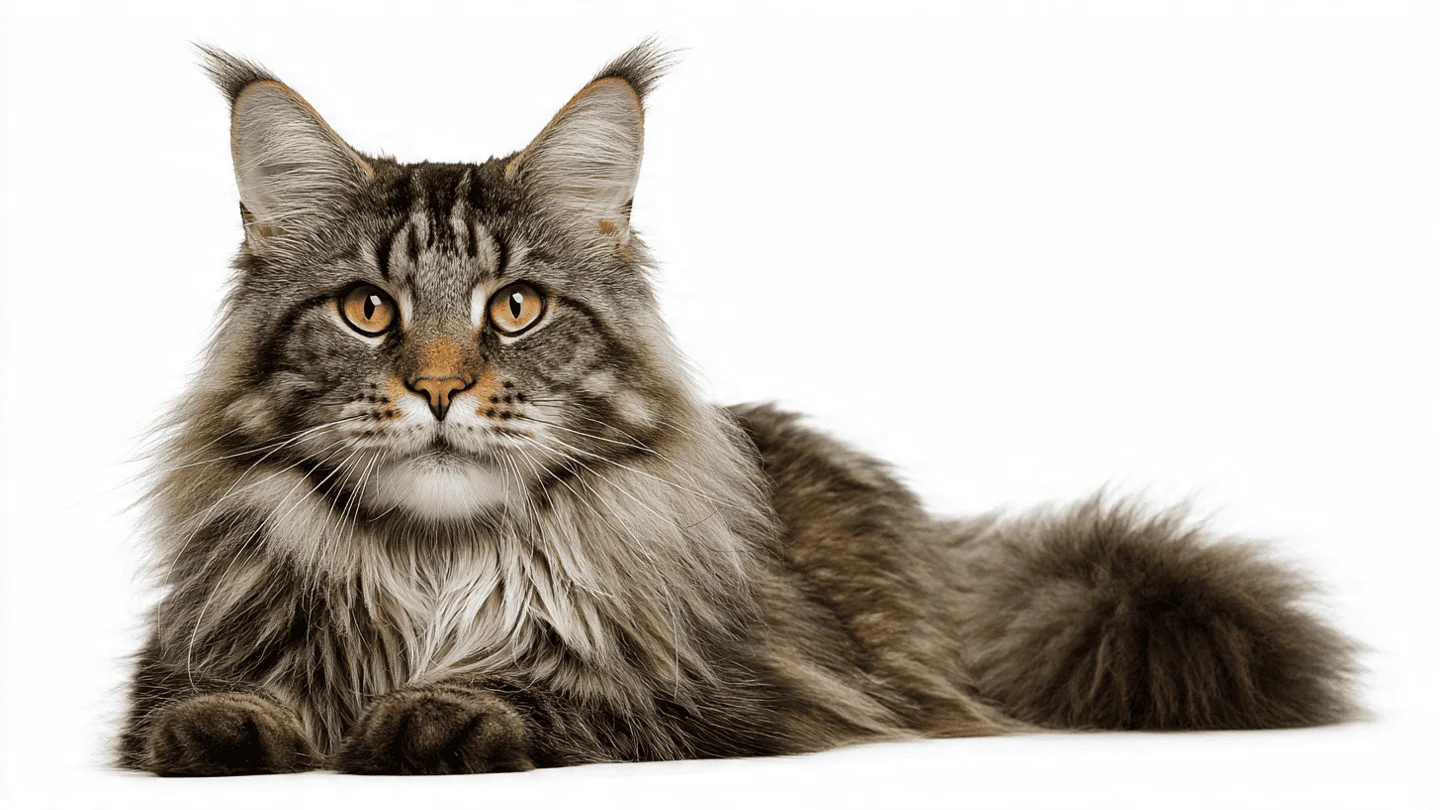
Its substantial body, long coat, tufted ears, bushy tail, and impressive paws give it an almost wild appearance. Behind that rugged exterior, however, is usually a sociable and adaptable companion.
Cat organizations, breeders, and owners often describe Maine Coons as gentle and friendly cats. Many enjoy participating in household life without demanding attention every minute.
The International Cat Association describes the breed as sweet-tempered, gentle, and friendly. Adult males commonly weigh around 18 to 22 pounds, while females are often around 12 to 15 pounds. Individual cats naturally vary.
History and Origins
The American state of Maine has a long connection with the Maine Coon, one of North America’s oldest established natural cat breeds.
Historical records do not fully document its ancestry, which has encouraged many colorful legends.
One old myth claimed that Maine Coons descended from crosses between domestic cats and raccoons. Biology makes that impossible.
A more realistic explanation links the breed to longhaired cats brought to North America by sailors and settlers.
Over generations, cats that could cope with harsh New England winters developed traits such as substantial bodies, long coats, bushy tails, and heavily furred paws.
Today, the Maine Coon remains closely connected with Maine and has become one of the most recognizable American cat breeds.
Physical Characteristics
The Maine Coon is a large, muscular cat with a rectangular body and a long, flowing coat.
Its appearance is substantial rather than delicate.
- Body: Large, muscular, and rectangular.
- Coat: Long and shaggy, with heavier fur around the chest and stomach.
- Ears: Large, often with prominent furnishings and tufts.
- Tail: Long, full, and bushy.
- Paws: Large and often heavily furnished with fur.
Their large paws, dense coat, and bushy tail reflect the breed’s development in a cold climate.
Maine Coons also mature relatively slowly. Some continue developing physically for several years before reaching their full adult appearance.
Temperament and Personality
One reason for the Maine Coon’s popularity is its combination of sociability and independence.
Many Maine Coons enjoy following their people around the home and observing whatever is happening.
They can be playful, curious, and highly interactive without constantly demanding physical attention.
At the same time, Maine Coons are not automatically lap cats.
Some prefer sitting nearby rather than being carried or held for long periods.
Their communication can also be distinctive. Maine Coons often use chirps, trills, soft meows, and other expressive sounds.
Individual personality still matters. Breed tendencies provide useful guidance, but they cannot predict exactly how every cat will behave.
Grooming and Daily Care
The Maine Coon’s coat needs regular attention.
Depending on coat texture and shedding, brushing once to several times each week can help remove loose fur and reduce tangles.
Pay particular attention to the stomach, chest, legs, and areas where friction can create knots.
Their large size should also influence your home setup.
A Maine Coon may benefit from sturdy scratching posts, large litter boxes, stable climbing structures, and resting areas that can comfortably support a substantial cat.
Interactive play remains important even when the cat appears calm.
Who May Enjoy Living With a Maine Coon?
A Maine Coon can be a strong match for people who want a large, sociable cat that enjoys being involved in family life.
They can adapt to different homes when they receive enough stimulation, companionship, and appropriate space.
Families should teach children how to handle cats respectfully. Introductions to dogs or other pets should also happen gradually.
If you enjoy an interactive companion with a big physical presence and do not mind regular coat maintenance, the Maine Coon deserves serious consideration.
Ragdoll: The Calm and Affectionate Companion
The Ragdoll is another large cat breed, but its character and appearance differ considerably from those of the Maine Coon.
People recognize Ragdolls for their blue eyes, semi-long coats, pointed coloration, and generally affectionate disposition.
The International Cat Association lists adult males at around 15 to 20 pounds and females at around 10 to 15 pounds. It also describes the breed as generally easy-going, affectionate, and calm.
History and Origins
The Ragdoll is a relatively modern breed.
Breeder Ann Baker developed it in California during the 1960s using selected domestic longhaired cats.
She focused on cats with the appearance and temperament she wanted and gradually established the foundation of the Ragdoll breed.
The breed’s unusual name came from stories that some of these cats became extremely relaxed when people held them.
However, not every Ragdoll displays this behavior.
The Cat Fanciers’ Association also notes that the extreme tendency to go limp does not define every modern Ragdoll.
Physical Characteristics
Ragdolls are large, substantial cats with moderately long coats.
Their vivid blue eyes are among their most recognizable characteristics.
They are pointed cats, meaning areas such as the face, ears, legs, and tail develop darker coloration than much of the body.
- Eyes: Large and blue.
- Body: Large, substantial, and well balanced.
- Coat: Semi-long, soft, and silky.
- Color pattern: Pointed coloration with several recognized patterns.
Different accepted patterns create considerable variation within the breed.
The coat has an elegant texture without the extremely dense, woolly feel found in some other longhaired breeds.
Temperament and Personality
Breed organizations and many owners describe Ragdolls as calm, social, and people-oriented.
Many enjoy following family members from room to room. Others prefer relaxing close to their people instead of constantly demanding attention.
They are often playful without having the relentless activity level associated with highly energetic breeds.
This balance can make the Ragdoll attractive to households looking for an affectionate indoor companion.
However, being a Ragdoll does not automatically mean a cat will enjoy being picked up.
Some love being held. Others prefer keeping their paws firmly on the ground.
Respecting the individual cat’s body language matters more than expecting stereotypical breed behavior.
Grooming and Daily Care
Although the Ragdoll has semi-long hair, owners can usually manage the coat with regular brushing.
One or two thorough grooming sessions each week may be enough for many cats.
You may need to increase grooming during shedding periods or whenever tangles start to develop.
Interactive play should also form part of daily life.
A calm personality does not eliminate a cat’s need to climb, scratch, explore, chase, and exercise.
Because Ragdolls can become substantial adults, owners should monitor body condition and encourage regular movement.
Who May Enjoy Living With a Ragdoll?
A Ragdoll may suit someone looking for a calm, affectionate cat that enjoys being around people.
They can live comfortably in apartments and family homes when their social and environmental needs are met.
People who want an extremely independent cat may find some Ragdolls more socially involved than expected.
On the other hand, someone looking for a high-energy athlete may find the breed too relaxed.
For households wanting a gentle companion with an elegant appearance, the Ragdoll can be an appealing option.
Bengal: The Athletic House Leopard
Few domestic cats attract attention quite like the Bengal.
Its muscular body, dramatic spots or rosettes, and sleek coat give it an unmistakably wild appearance.
The personality, however, matters just as much as the appearance.
Bengals are commonly energetic, intelligent, curious, and highly interactive.
The International Cat Association describes them as inquisitive, spirited, social, and people-oriented. Adult males commonly weigh around 9 to 15 pounds, while females often weigh around 6 to 12 pounds.
History and Origins
The history of the Bengal differs significantly from that of most domestic breeds.
In 1963, Jean S. Mill crossed a domestic cat with an Asian leopard cat, a small wild feline species native to Asia.
The modern Bengal breeding program developed further during the early 1980s.
TICA accepted the Bengal as a new breed in 1986 and later granted it championship status in 1991.
Modern domestic breeders pair Bengals with other Bengals.
Today’s cats retain the striking appearance that made the breed famous while breeders select them as domestic companions.
Physical Characteristics
The Bengal is generally medium to large, athletic, muscular, and agile.
Its coat is the feature that attracts attention first.
Bengals may display spotted, rosetted, or marbled patterns.
- Body: Muscular, athletic, and agile.
- Coat: Short, soft, and relatively easy to maintain.
- Pattern: Spotted, rosetted, or marbled.
- Appearance: Wild-looking markings combined with a domestic cat body.
Rosettes are especially striking because they resemble markings seen on some wild cats.
Some Bengals also display a visual effect commonly called “glitter.” Individual hairs reflect light and give the coat a subtle shimmering appearance.
Temperament and Personality
A Bengal’s activity level is one of the most important things prospective owners should understand.
These cats often want to climb, investigate, chase, learn, and interact.
They may explore shelves, doors, cabinets, high furniture, and places an owner never expected a cat to reach.
Many Bengals respond well to interactive games and training.
Some learn to retrieve toys, walk with appropriate harness training, solve food puzzles, or perform simple behaviors through reward-based training.
Their intelligence can make them highly entertaining companions.
However, intelligence combined with insufficient stimulation can also create challenges.
A bored Bengal may invent activities that its human family does not particularly appreciate.
Grooming and Daily Care
Coat maintenance is comparatively easy.
A weekly brushing is generally enough for many Bengals.
Environmental enrichment requires much more attention.
Tall cat trees, sturdy climbing spaces, interactive toys, puzzle feeders, scratching surfaces, scheduled play sessions, and opportunities to explore can help channel their energy.
Rotating toys can also prevent the environment from becoming too predictable.
A Bengal should not be chosen only because of its appearance.
People considering the breed should feel comfortable living with an intelligent, active cat that may expect substantial interaction.
Who May Enjoy Living With a Bengal?
The Bengal may appeal to experienced or highly engaged cat owners who enjoy interactive play and training.
It can also suit active households prepared to provide significant physical and mental enrichment.
Someone looking for a cat that spends most of the day quietly sleeping on the sofa may prefer another breed.
For the right household, however, the Bengal’s curiosity and athleticism can make everyday life remarkably entertaining.
You can also explore Bengal videos and other feline behavior content through the MeowKats CaTube TV section.
British Shorthair: The Calm Independent Companion
The British Shorthair offers a very different experience.
Instead of the Bengal’s constant activity or the Maine Coon’s social curiosity, people typically associate British Shorthairs with calmness, patience, and a degree of independence.
They have a sturdy body, rounded head, dense coat, and distinctive teddy-bear appearance.
According to TICA, females commonly weigh around 8 to 11 pounds and males around 10 to 16 pounds. The organization describes the breed as gentle, quiet, affectionate, and independent.
History and Origins
The British Shorthair has a long history in Britain.
Its ancestry is associated with domestic cats that accompanied the Romans into Britain and later mixed with local cat populations.
Over many generations, these cats developed into sturdy working cats suited to the British environment.
Organized breeders later refined the breed and helped establish it as one of the foundational breeds of the modern cat fancy.
The two World Wars significantly reduced breeding populations.
Afterward, breeders used carefully selected outcrosses to help preserve and rebuild the breed.
Cat associations around the world now recognize the British Shorthair.
Physical Characteristics
The British Shorthair is compact, powerful, and heavily built.
Its broad chest, rounded head, full cheeks, and dense coat create the famous teddy-bear appearance.
The coat is short but unusually plush.
- Body: Compact, powerful, and sturdy.
- Head: Broad and rounded.
- Eyes: Large and round.
- Coat: Short, dense, and plush.
- Colors: Available in many colors and patterns.
British Blue, the solid blue-gray variety, is probably the most recognizable color.
However, British Shorthairs appear in many other colors and patterns.
Large round eyes add to their characteristic expression.
Temperament and Personality
British Shorthairs are often affectionate without being demanding.
Many enjoy staying near family members while maintaining a comfortable degree of independence.
Instead of constantly climbing onto your lap, a British Shorthair may simply settle beside you.
Many also prefer having all four paws supported rather than being carried frequently.
Their generally calm temperament can appeal to people who appreciate a quieter household.
However, independence should not be confused with a lack of social needs.
British Shorthairs still benefit from attention, interaction, play, predictable routines, and environmental enrichment.
Grooming and Daily Care
The short coat makes grooming relatively straightforward.
Weekly brushing can help remove loose fur, and owners may increase grooming during heavier shedding periods.
Weight management also deserves attention.
Because the breed is generally less hyperactive than a Bengal, owners should encourage regular movement through interactive toys and play sessions.
Owners should adjust food portions to the cat’s age, size, activity level, and veterinary recommendations.
Who May Enjoy Living With a British Shorthair?
The British Shorthair may appeal to people looking for a calm, relatively independent companion.
Its temperament can suit apartments as well as larger homes, provided the cat receives appropriate enrichment and attention.
Busy households may appreciate a cat that does not constantly demand interaction.
However, even an independent cat still needs companionship and mental stimulation.
For someone who enjoys quiet companionship and an easy-care coat, the British Shorthair is worth considering.
Maine Coon vs Ragdoll vs Bengal vs British Shorthair: Direct Comparison
Breed standards describe general tendencies, but individual cats always vary.
The following table provides a practical overview of the main differences between these four popular cat breeds.
| Feature | Maine Coon | Ragdoll | Bengal | British Shorthair |
|---|---|---|---|---|
| Typical Adult Size | Large | Large | Medium to large | Medium to large |
| Male Weight | About 18–22 lb | About 15–20 lb | About 9–15 lb | About 10–16 lb |
| General Activity | Moderate to active | Calm to moderate | High | Low to moderate |
| Coat | Long and shaggy | Semi-long and silky | Short | Short and very dense |
| Grooming | Moderate to high | Moderate | Low | Low to moderate |
| Social Style | Friendly and involved | Affectionate and relaxed | Interactive and curious | Affectionate but independent |
| Training Potential | Good | Good | Very good | Moderate |
| Apartment Potential | Possible with enrichment | Generally good | Possible with substantial enrichment | Generally good |
| May Suit | Social households | Calm companion seekers | Active, engaged owners | Quieter households |
No table can determine the perfect breed for a particular person.
Your schedule, home environment, budget, expectations, other pets, and willingness to provide enrichment matter just as much as general breed tendencies.
Which Cat Breed Fits Your Lifestyle?
Instead of asking which breed is “best,” consider what everyday life with each cat might look like.
For an Active Family
A Maine Coon may fit well into a socially active household.
Many enjoy interacting with several family members and participating in everyday activities.
A Bengal can also thrive in an active environment, but its exercise and enrichment requirements are usually higher.
Families with young children should supervise interactions regardless of breed and teach children to respect a cat’s boundaries.
For Someone Wanting a Relaxed Companion
The Ragdoll and British Shorthair deserve particular consideration.
Ragdolls are often more openly social and affectionate, while British Shorthairs may express affection in a more independent way.
The distinction matters if you have strong expectations about physical contact.
A calm breed can still enjoy play and social interaction, so owners should not confuse lower energy with a lack of needs.
For Apartment Living
Apartment size alone does not determine whether a cat will be happy.
The quality of the environment matters enormously.
Vertical territory, scratching areas, comfortable resting places, window views, interactive play, and human companionship can transform a relatively small home into an excellent feline environment.
Ragdolls and British Shorthairs may adapt particularly well to quieter apartment living.
Maine Coons can also live in apartments when enough space and enrichment are available.
A Bengal requires more deliberate planning because of its higher activity level.
For People Who Enjoy Training Cats
The Bengal is an obvious candidate for people interested in training.
Its curiosity and energy often make training an enjoyable way to provide mental stimulation.
Maine Coons and Ragdolls can also learn behaviors and participate in reward-based training.
The important factor is not forcing a cat to perform. Training should remain enjoyable and rewarding.
For People Concerned About Grooming
The Bengal generally requires the least coat maintenance of these four breeds.
British Shorthairs also have short coats, although their dense fur benefits from regular brushing.
Ragdolls require more grooming than most shorthaired cats.
The Maine Coon generally needs the most consistent coat maintenance in this comparison.
Living With These Breeds in Everyday Life
Choosing a breed is easier when you imagine daily life instead of focusing only on appearance.
A beautiful cat can still become a poor lifestyle match when its activity level, social needs, or grooming requirements differ greatly from what an owner expected.
Time and Interaction
Bengals usually require the most deliberate interaction and stimulation in this comparison.
Maine Coons also enjoy being involved in household activity, although their energy can feel less intense.
Ragdolls often seek companionship in a calmer way.
British Shorthairs may value more personal space, but they still need regular attention and play.
Space and Enrichment
A large home does not automatically create a better environment for a cat.
Cats use vertical space as well as floor space.
Cat trees, shelves, scratching posts, tunnels, puzzle feeders, window perches, and rotating toys can make a significant difference.
This becomes especially important for Bengals and other active cats.
Other Pets
Breed tendencies can provide clues about sociability, but introductions determine much of the outcome.
Introduce cats and dogs gradually and give each animal access to safe spaces.
Never assume two animals will get along simply because their breeds have friendly reputations.
Individual temperament and previous experience matter greatly.
Remember: Breed Is Only Part of the Cat
Breed characteristics are useful when choosing a companion, but they are not guarantees.
Genetics, early socialization, life experiences, environment, health, and individual personality all influence behavior.
Two cats from the same breed can have noticeably different personalities.
This matters especially when adopting an adult cat.
An adult cat’s established behavior can sometimes tell you more about compatibility than breed expectations alone.
Spend time with the individual cat whenever possible.
Ask breeders, shelters, or rescue organizations about temperament, activity, handling preferences, social history, and health.
A good match depends on understanding the cat in front of you rather than choosing solely from photographs.
Use MeowKats Tools Before You Decide
Still unsure which breed matches your lifestyle?
The MeowKats Cat Breed Finder can help you narrow your options according to your preferences and everyday lifestyle.
Once you have several possible matches, explore each one through the MeowKats Cat Breed Directory.
The directory lets you examine breed profiles, appearance, personality, and other useful characteristics in greater detail.
You can then use the MeowKats Cat Breed Comparison Tool to place your preferred breeds side by side.
A Simple Three-Step Approach
- Start with the Cat Breed Finder to discover potential matches.
- Explore the Breed Directory to learn more about each breed.
- Use the Breed Comparison Tool to compare your finalists side by side.
These tools work together and can make the research process much easier than opening dozens of separate breed pages.
Finding the Right Match
The Maine Coon, Ragdoll, Bengal, and British Shorthair represent four very different approaches to feline companionship.
The Maine Coon combines impressive size with a sociable and involved personality.
The Ragdoll offers a generally calm and affectionate presence.
The Bengal brings athleticism, intelligence, curiosity, and considerable energy.
The British Shorthair combines quiet affection with greater independence.
None is automatically better than the others.
The right choice depends on what you can offer a cat and what kind of relationship you hope to build.
Think about your available time, home environment, grooming commitment, preferred activity level, other pets, and expectations for physical affection.
Then look beyond the breed name and consider the individual cat.
A thoughtful match benefits both sides and creates a stronger foundation for years of companionship.
Before making your decision, explore the MeowKats Cat Breed Finder, browse the Breed Directory, and use the Cat Breed Comparison Tool to examine your favorite breeds side by side.
Professional Sources & Further Reading
- The International Cat Association (TICA) — Maine Coon Breed Profile.
Breed characteristics, temperament, size, history, and general breed information.
View source - The International Cat Association (TICA) — Ragdoll Breed Profile.
Breed temperament, size, activity, appearance, and history.
View source - The International Cat Association (TICA) — Bengal Breed Profile.
Bengal temperament, appearance, activity level, and breed characteristics.
View source - The International Cat Association (TICA) — Bengal Breed History.
Background on the development and recognition of the Bengal breed.
View source - The International Cat Association (TICA) — British Shorthair Breed Profile.
Breed history, temperament, size, and physical characteristics.
View source - The Cat Fanciers’ Association (CFA) — Ragdoll Breed Profile.
Information about Ragdoll history, appearance, and temperament.
View source - The Cat Fanciers’ Association (CFA) — British Shorthair Breed Profile.
Physical characteristics, temperament, and breed-standard information.
View source
Frequently Asked Questions
Choosing the Right Breed for Your Lifestyle
Which is better for an apartment: Maine Coon, Ragdoll, Bengal, or British Shorthair?
Ragdolls and British Shorthairs often adapt well to apartment living because of their generally calmer activity levels.
However, apartment suitability depends heavily on enrichment.
A Maine Coon can also live successfully in an apartment if it has enough usable space, sturdy climbing structures, and daily interaction.
A Bengal can live in an apartment too, but owners need to provide considerably more opportunities for climbing, play, exploration, and mental stimulation.
Which of these four cat breeds is the most active?
The Bengal is generally the most energetic of the four.
Bengals are known for climbing, exploring, playing, and seeking interactive activities.
Maine Coons can also be playful, while Ragdolls and British Shorthairs are generally calmer.
Which breed requires the least grooming?
The Bengal normally requires the least coat maintenance because of its short coat.
British Shorthairs are also relatively straightforward to groom, although their dense coat benefits from regular brushing.
Ragdolls need routine grooming, while Maine Coons usually require the most coat maintenance of the four breeds.
Are Maine Coons good family cats?
Many Maine Coons are social, friendly, and comfortable in active households.
However, successful family life depends on the individual cat and respectful interaction.
Children should learn not to chase, squeeze, disturb, or forcibly carry cats.
Which breed is usually calmer: Ragdoll or British Shorthair?
Both breeds generally have calmer temperaments than highly active breeds such as the Bengal.
Ragdolls often seek more direct interaction with people, while British Shorthairs may show affection in a more independent way.
Individual personality can still create major differences between cats.
Temperament, Care, and Breed Differences
Does every Ragdoll go limp when picked up?
No.
Although the breed’s name comes from this famous reputation, not every Ragdoll becomes limp when held.
Individual cats have different personalities and handling preferences.
Never assume a cat wants you to pick it up simply because of its breed.
Do Bengals need a special diet because of their wild ancestry?
Modern domestic Bengals do not automatically need a special “wild” diet.
They need nutritionally complete food appropriate for domestic cats.
A veterinarian can recommend an appropriate diet when a Bengal has specific health or nutritional requirements.
Which breed may suit someone who works during the day?
A British Shorthair may appeal to people who want a relatively independent cat.
Some Ragdolls and Maine Coons may prefer more frequent social interaction.
However, do not choose any breed with the expectation that it needs no companionship.
Interactive play, enrichment, routine, and quality time remain important for every cat.
Is a Bengal suitable for a first-time cat owner?
Yes, it can be.
However, prospective owners need to understand the Bengal’s high activity and enrichment needs.
A committed first-time owner who learns about feline behavior and provides sufficient interaction may do very well with a Bengal.
Someone looking for a quiet, low-engagement pet may find the breed challenging.
Which is more affectionate: a Maine Coon or a Ragdoll?
Both breeds often form strong social bonds, but they may express affection differently.
Many Ragdolls enjoy close physical contact and staying near their people.
Maine Coons often participate actively in household life and may follow family members from room to room.
Individual personality matters more than expecting every cat from a breed to behave in exactly the same way.
How can I compare these breeds before choosing one?
Start with the MeowKats Cat Breed Finder to identify breeds that may suit your lifestyle.
Next, explore each breed through the MeowKats Breed Directory.
Finally, use the MeowKats Cat Breed Comparison Tool to compare your preferred breeds side by side before making your decision.