
Article Outline & Quick Navigation
Select any topic below to jump directly to that section.
Hunger and Thirst Can Trigger Meowing
Greeting You Is Another Reason Cats Meow
Boredom Can Make Cats More Vocal
Stress and Anxiety Can Increase Meowing
Meowing Can Signal Pain or Illness
Mating Behavior and Vocalization
Senior Cats and Increased Vocalization
What Do Different Cat Meows Mean?
Body Language Gives the Meow Its Meaning
How to Manage Excessive Meowing
When Should You Worry About Meowing?
Learning Your Cat’s Personal Meow Language
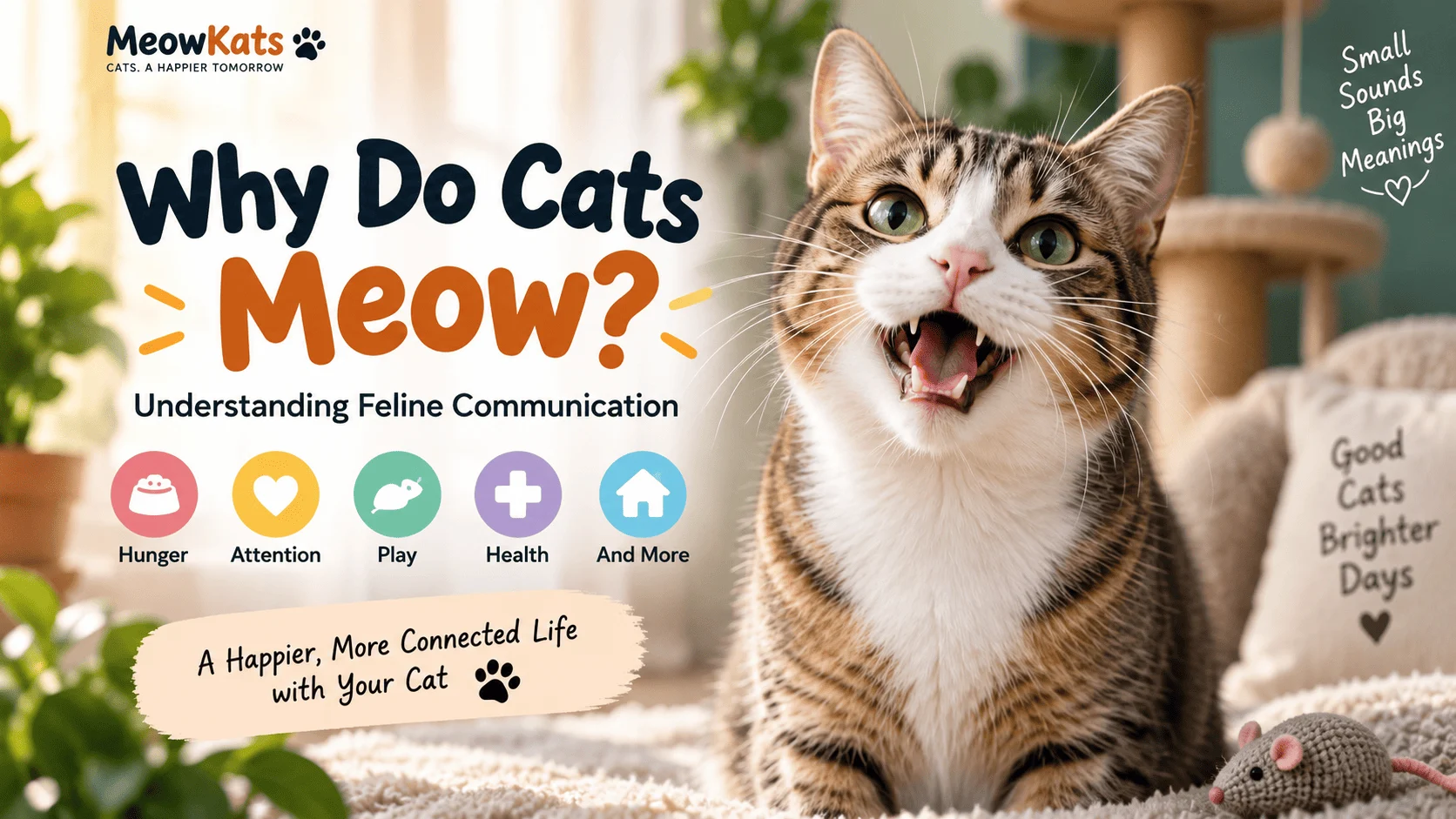
Cats are famous for their voices. They purr, chirp, trill, hiss, growl, yowl, and, of course, meow. Yet the familiar meow is far more complex than it first appears. Similar sounds can appear in several situations, while their meaning changes according to what is happening around the animal. This is why the question why do cats meow has many different answers.
A short vocalization when you arrive home may simply be a greeting. Several repeated meows beside an empty food bowl are more likely to be a request for dinner. During the night, a prolonged cry can have a completely different explanation, ranging from boredom and reproductive behavior to stress, confusion, or physical discomfort.
Sound is only one part of feline communication. Cats also communicate through posture, facial expressions, tail movement, ear position, scent, touch, and eye contact. Understanding what your cat is trying to communicate therefore requires looking at the entire situation rather than focusing on the voice alone.
Why Do Cats Meow at Humans?
One of the most fascinating features of domestic cat behavior is the important role meowing plays in communication with humans. Kittens naturally vocalize to communicate with their mothers. A young kitten may call when it is hungry, cold, frightened, uncomfortable, or separated from the nest. As cats mature, communication with other cats relies heavily on scent, posture, facial signals, touch, and several types of vocalization.
Adult domestic cats, however, continue to use meows frequently when interacting with people. Research into feline vocal communication has found that meows can differ acoustically according to context. Human listeners are not always able to identify the situation accurately from an unfamiliar cat’s voice alone, which shows why context matters so much.[1]
Experience also influences vocal behavior. A cat learns which actions produce useful responses. Meowing beside the kitchen may result in food, while vocalizing beside a closed door may persuade someone to open it. Repeated success can strengthen those patterns.
Over time, individual cats can develop highly personal communication habits. An owner may recognize one sound before breakfast, another during play, and a different call when the cat wants access to a room. Both the human and the cat gradually learn from these repeated interactions.
For a deeper look at this relationship, read our guide on how cats communicate with humans.
Why Cats Meow for Attention
Seeking attention is one of the most common reasons behind feline meowing. Domestic cats can form strong social relationships with the people they live with. Some enjoy sitting beside their owners, while others follow people through the house, sleep nearby, or regularly ask for interaction.
A vocal request may mean that your cat wants affection, play, conversation, or simple acknowledgement. Some cats even appear to participate in short vocal exchanges. A person speaks, the cat responds, and the interaction continues. Although this is not human language, vocalizing can become an effective way for a cat to maintain social contact.
Attention-seeking behavior may become excessive when every meow immediately produces a reward. If vocalizing consistently leads to food, play, petting, or another desired response, the cat may begin using that strategy more frequently.
Regular interaction remains important. The goal is not to ignore a social cat but to provide predictable affection and play without teaching it that persistent vocal demands are the only way to receive attention. The ASPCA also identifies greeting people and requesting attention among common reasons cats meow.[2]
Hunger and Thirst Can Trigger Meowing
Food is another major trigger for feline vocalization. Many cats develop an excellent sense of routine and seem to know when breakfast or dinner should arrive. Sitting beside the food bowl and calling shortly before the usual feeding time can become a daily ritual.
Environmental cues are also important. Opening a cupboard, touching a food container, walking toward the kitchen, or opening the refrigerator may immediately produce excited vocalization. Water can prompt communication too, particularly when a bowl is empty or a familiar routine has changed.
A predictable feeding schedule can help reduce constant food-related demands. However, providing food every time a cat vocalizes may unintentionally reinforce the behavior. Persistence becomes worthwhile when it repeatedly produces a meal or treat.
Sudden changes in appetite deserve a different response. Increased hunger accompanied by weight loss, increased thirst, restlessness, or other behavioral changes should not automatically be dismissed as ordinary begging. A veterinarian can help determine whether a medical cause is involved.
Greeting You Is Another Reason Cats Meow
Sometimes a cat vocalizes for a very simple reason: it has noticed someone familiar. Greeting sounds commonly occur when an owner comes home, enters a room, wakes up in the morning, or approaches a resting cat.
Friendly greetings are often accompanied by relaxed body language. An upright tail, rubbing against the legs, purring, trilling, or relaxed eye contact can all appear alongside short meows. Repeated interactions like these may become part of the daily relationship between a cat and its human family.
Personality strongly affects how vocal the greeting becomes. A quiet cat may show affection primarily through body language, while another announces every arrival with several sounds. Breed tendencies can influence vocal behavior too, although individual variation remains substantial.
You can explore some unusual vocal abilities in our article about cat breeds that can copy human speech.
Boredom Can Make Cats More Vocal
Boredom can contribute to increased meowing, particularly in indoor cats. Food, water, shelter, and comfortable sleeping areas are essential, but cats also benefit from opportunities to climb, scratch, stalk, chase, hide, explore, observe, and play.
Without enough stimulation, a cat may follow its owner constantly, vocalize repeatedly, disturb people at night, or demand interaction. In some households, making noise becomes a reliable way to create activity. Even a negative human response may provide stimulation when the environment offers little else.
Environmental enrichment can help. Wand toys, puzzle feeders, scratching posts, cat trees, shelves, tunnels, window perches, cardboard boxes, and rotating toys create different opportunities for exploration. Changing available activities periodically can also help maintain interest.
Short daily play sessions are particularly valuable because they give cats opportunities to stalk and chase safely. Following play with a meal can fit naturally into a sequence of activity, eating, grooming, and resting.
Stress and Anxiety Can Increase Meowing
Predictability matters to many cats. Moving home, introducing another pet, welcoming a baby, hosting unfamiliar visitors, rearranging furniture, construction work, loud noises, or changes in an owner’s schedule can all affect feline behavior.
Increased vocalization may appear alongside hiding, altered eating, overgrooming, avoidance, clinginess, or defensive behavior. Some cats seem to seek reassurance from familiar people, while others become more vocal because their surroundings feel less predictable.
Providing safe hiding places and quiet resting areas can help a cat cope with environmental change. Food, water, litter boxes, scratching surfaces, and sleeping locations should remain easy to reach. Familiar routines also provide useful stability.
Multi-cat households require additional planning. Competition over food, litter boxes, resting sites, or narrow pathways can create tension even without obvious fighting. Providing several separated resources gives cats more control over their environment and can reduce unnecessary conflict.
Meowing Can Signal Pain or Illness
Not every meow is a social request or learned behavior. Increased vocalization can sometimes accompany pain, illness, or physical discomfort. One of the most useful signs an owner can notice is a sudden change from the cat’s normal vocal pattern.
A naturally talkative cat may produce many sounds every day without having a problem. In contrast, a normally quiet cat that suddenly begins crying repeatedly deserves closer attention. The voice should be considered together with changes elsewhere in the cat’s behavior.
Look at appetite, thirst, movement, litter-box habits, grooming, sleep, posture, breathing, and social interaction. Vocalizing while jumping, walking, being touched, or settling down may indicate that an activity has become uncomfortable.
Cats can conceal discomfort effectively, which makes subtle behavioral changes important. Withdrawal, reduced activity, unusual irritability, changes in sleep, or sensitivity to touch may justify veterinary evaluation.
Urinary Warning Signs Need Prompt Attention
Urinary problems are especially important. Repeated litter-box visits, straining, crying during urination, or producing very little urine can indicate lower urinary tract disease. A complete urethral obstruction is a veterinary emergency and requires immediate treatment, particularly because affected cats may be unable to pass urine at all.[4]
Mating Behavior and Vocalization
Reproductive behavior can produce some of the loudest sounds cats make. An unspayed female in heat may produce prolonged calls that differ noticeably from ordinary conversational meows. Restlessness, increased affection, rolling, raised hindquarters, and attempts to go outdoors may appear at the same time.
Intact males can also become highly vocal after detecting a female in heat nearby. Pacing around doors or windows, roaming, urine marking, fighting, and repeated calling can all occur.
Hormones strongly influence these behaviors. Spaying and neutering usually reduce vocalization associated specifically with mating. They do not eliminate meowing caused by hunger, attention, boredom, stress, pain, personality, or other unrelated factors.
For a broader explanation of feline reproductive behavior, read Meows, Minutes and Mating: The Complete Cat Cycle Explained.
When a Cat Wants Access
Sometimes the explanation behind persistent meowing is extremely simple: a cat wants access to another space. Bedrooms, balconies, gardens, cupboards, windows, and temporarily closed rooms can all become targets for vocal requests.
Many owners recognize the familiar pattern. A cat calls beside a closed door until someone opens it, walks through, explores briefly, and may soon ask to return. What seems unnecessary to a person can make sense to an animal that regularly monitors its territory.
Windows can create similar behavior. Birds, insects, wildlife, or neighborhood cats may trigger chirping, chattering, or meowing. Before searching for a complicated explanation, look at where your cat is standing and what has captured its attention.
Why Do Cats Meow at Night?
Nighttime meowing is particularly noticeable because it interrupts human sleep. Several explanations are possible. Cats often become more active around dawn and dusk, while an indoor cat that sleeps throughout much of the day may still have considerable energy late at night.
Young cats may want to play, whereas others anticipate an early breakfast. Animals visible outside can create excitement or territorial tension. Closed bedroom doors may also lead to attention-seeking calls.
Stress, routine changes, and reproductive behavior provide additional explanations. Senior cats deserve particular attention because nighttime vocalization can sometimes accompany changes in hearing, vision, physical health, sleep patterns, or cognitive function.
Observe what happens immediately before and after the sound. More daytime enrichment and an active evening play session may help when unused energy contributes to the behavior. At the same time, repeatedly waking to provide treats or entertainment after every demand meow can establish a learned nighttime routine.
For a detailed guide to this specific behavior, read why cats meow at night.
Senior Cats and Increased Vocalization
Aging can change the way a cat experiences its surroundings. Hearing, vision, mobility, sleep, and physical comfort may all change over time. Cornell notes that cats can live well into their senior years and that aging itself is not a disease, although older cats are more likely to develop medical conditions.[3]
Cognitive changes can also influence vocal behavior. Feline cognitive dysfunction may involve disorientation, changes in sleep-wake cycles, altered activity, and episodes of loud vocalization, including calls during the night.[5]
Reduced hearing may change the volume of a cat’s voice because it no longer hears itself in the same way. Visual changes can make dark or unfamiliar areas harder to navigate. Mobility problems may also make access to familiar resources more difficult.
New vocalization should not simply be attributed to age. A significant behavioral change in a senior cat deserves veterinary evaluation. At home, keep food, water, litter boxes, and resting areas easy to reach. Familiar layouts and gentle nighttime lighting may also help a cat that appears disoriented after dark.
Naturally Talkative Cats
Every cat has an individual communication style. Some cats rarely meow, while others appear to comment on almost everything happening around them. Genetics, personality, socialization, early experience, environment, and learned behavior can all influence vocalization.
Siamese cats are particularly well known for being vocal, and related breeds may also communicate frequently. The ASPCA specifically notes that Siamese cats can be especially prone to frequent meowing and yowling.[2]
Breed alone cannot predict exactly how talkative an individual cat will become. A mixed-breed cat may be extremely communicative, while another cat from a vocal breed may remain comparatively quiet.
The most useful comparison is therefore your cat with its own usual behavior. Long-standing talkativeness may simply reflect personality. A sudden and unexplained increase in vocalization deserves more attention.
What Do Different Cat Meows Mean?
There is no universal feline dictionary in which every sound has one exact translation. Research examining meows recorded during food waiting, isolation, and brushing found acoustic differences between contexts. Human listeners, however, were not consistently able to identify those contexts from the sounds alone.[1]
This is why context remains essential. Pitch, duration, repetition, body language, location, and timing can all help explain what a particular vocalization may mean.
Short Meows
A brief meow often functions as a greeting or an attempt to attract attention. Relaxed posture and friendly social behavior usually support that interpretation.
Repeated Meows
Repetition often suggests stronger motivation. Food, play, social contact, access to another space, or an environmental event may be driving the vocalization.
Long or Drawn-Out Meows
A prolonged meow or yowl can accompany frustration, urgency, reproductive behavior, distress, or a strong demand. An unfamiliar sound that appears suddenly deserves closer attention.
High-Pitched Sounds
Higher-pitched sounds may occur during greetings, excitement, urgent requests, or discomfort. Because individual voices differ, compare the sound with what is normal for your own cat.
Low-Pitched Vocalizations
Lower sounds may accompany warning, territorial behavior, frustration, or displeasure. Flattened ears, a tense posture, large pupils, or rapid tail movement can provide additional clues.
For a broader explanation of feline sounds, visit our guide to understanding cat meows.
Body Language Gives the Meow Its Meaning
A vocalization should not be interpreted in isolation. An approaching cat with an upright tail, relaxed eyes, and a short meow communicates something very different from an animal crouching in a corner and producing repeated cries.
Watch the ears, tail, eyes, and overall posture. Slow blinking and a relaxed body generally suggest a different emotional state from flattened ears, stiff movement, an arched back, or rapid tail motion.
Communication between cats and humans is also multimodal. Research has shown that cats respond to combinations of human visual and vocal signals, supporting the idea that communication involves more than sound alone.[6]
Timing and location add valuable information. A vocalization beside a food bowl probably has a different meaning from one produced while watching another animal through a window. Repeated patterns often reveal more than the sound itself.
How to Manage Excessive Meowing
The first step is identifying the cause rather than immediately treating the cat as demanding. Check whether food, fresh water, clean litter boxes, comfortable resting areas, scratching opportunities, play, safe hiding places, and appropriate social interaction are available.
Next, consider recent environmental changes. A new pet, unfamiliar visitors, construction, altered furniture, a new work schedule, or different feeding times can influence vocal behavior.
Health should also be considered before treating excessive meowing as a training problem. Sudden vocalization combined with changes in appetite, thirst, urination, mobility, grooming, sleep, or social behavior deserves closer attention.
Avoid Accidentally Rewarding Demand Meowing
Once genuine needs and medical concerns have been addressed, learned behavior can be managed consistently. Imagine a cat repeatedly calling for treats. If the owner eventually gives one simply to stop the noise, persistence has been rewarded.
A better approach is to provide valued resources at appropriate times and reinforce calmer behavior. Household consistency also matters. When one person ignores demand meowing but another immediately responds with food or attention, the pattern can continue.
Why Punishment Does Not Help
Punishment is not an appropriate response to normal feline communication. Shouting, spraying water, frightening a cat, or using physical punishment does not explain what behavior is expected instead. Fear and stress may increase, while trust between the cat and owner can be damaged.
Address the cause rather than the sound. More enrichment can help with boredom, while a predictable feeding routine may reduce food-related demands. Environmental stress requires greater security, access to resources, and stable routines.
Learned vocal behavior should be managed by changing when rewards occur. When pain, illness, or age-related changes are possible, veterinary evaluation is more appropriate than attempting to suppress the vocalization.
When Should You Worry About Meowing?
Frequent vocalization is not automatically abnormal because some cats naturally communicate more than others. A significant change from an established pattern is usually more informative than the total number of meows.
Pay attention when a cat suddenly becomes much louder, vocalizes far more frequently, or produces unfamiliar sounds. Changes in appetite, weight, thirst, mobility, breathing, urination, sleep, or behavior can provide additional clues.
New nighttime calling in a senior cat also deserves evaluation rather than being dismissed as an inevitable part of aging. Sensory, medical, and cognitive changes can all influence behavior.
Difficulty urinating is especially urgent. Repeated attempts to urinate with little or no urine, particularly when accompanied by crying or distress, require prompt veterinary care because complete obstruction can become life-threatening.[4]
Learning Your Cat’s Personal Meow Language
To some degree, people can learn the individual communication patterns of a cat they know well. A breakfast call may sound different from a greeting, while another sound may appear consistently beside a closed door or before play.
Meaning becomes easier to interpret because owners combine sound with timing, posture, location, and previous experience. Over months or years, familiar patterns can become recognizable even when they would mean very little to a stranger.
Your cat is learning at the same time. It notices which sounds attract attention, which behaviors make doors open, when food usually appears, and how people respond to different requests.
Communication is therefore a two-way learning process. Human behavior influences feline behavior, while the cat’s signals gradually teach people what tends to happen in different situations.
Understanding Your Cat’s Communication
So, why do cats meow? No single explanation applies to every situation. Food, attention, play, companionship, access, reassurance, excitement, stress, reproductive behavior, discomfort, confusion, and personality can all influence vocalization.
Context gives the sound its meaning. Consider where the cat is standing, what it is looking at, how its body is positioned, what happened immediately beforehand, and whether anything has recently changed.
Learning your cat’s usual communication patterns makes unusual behavior easier to recognize. Enrichment, predictable routines, comfortable resources, and regular social interaction can also prevent some unnecessary vocal demands.
Most importantly, take sudden changes seriously. Cats communicate constantly through sound, movement, posture, and behavior. Careful observation can help you respond appropriately while building a better understanding of your feline companion.
Frequently Asked Questions About Why Cats Meow
What makes a cat meow repeatedly at its owner?
Food, attention, play, access, and social interaction are common reasons. A sudden increase can also accompany stress, discomfort, or illness.
Is a greeting meow normal when I come home?
Yes. Short vocalizations accompanied by relaxed posture, rubbing, purring, or an upright tail are often friendly greetings.
What causes nighttime meowing?
Possible causes include hunger, unused energy, boredom, attention seeking, stress, outdoor activity, reproductive behavior, or age-related changes.
Is meowing before meals normal?
Yes. Cats quickly learn feeding schedules and may vocalize when they recognize familiar times, sounds, locations, or actions associated with food.
Should persistent meowing be ignored?
First rule out genuine needs and health concerns. If the behavior is a learned demand, rewarding calm moments instead may be more effective.
What can cause a sudden increase in vocalization?
Stress, pain, illness, increased hunger, environmental changes, reproductive behavior, sensory decline, and cognitive changes are possible causes.
Do adult cats vocalize toward other cats?
Yes, but they also rely heavily on scent, posture, facial signals, touch, and other vocal sounds when communicating with one another.
Can spaying or neutering reduce loud calling?
It commonly reduces vocalization associated with reproductive behavior, but it will not eliminate meowing caused by unrelated needs or conditions.
Can vocal behavior change as a cat ages?
Yes. Hearing, vision, mobility, sleep, physical health, and cognitive function can all influence vocalization in senior cats.
When does meowing require urgent veterinary attention?
Seek urgent care when vocalization accompanies severe pain, breathing difficulty, collapse, or repeated attempts to urinate with little or no urine.
References and Further Reading
- Prato-Previde E, Cannas S, Palestrini C, Ingraffia S, Battini M, Ludovico LA, Ntalampiras S, Presti G, Mattiello S.
What’s in a Meow? A Study on Human Classification and Interpretation of Domestic Cat Vocalizations.
Animals. 2020;10(12):2390.
DOI: 10.3390/ani10122390. - American Society for the Prevention of Cruelty to Animals (ASPCA).
Meowing and Yowling.
ASPCA Pet Care. - Cornell University College of Veterinary Medicine, Cornell Feline Health Center.
Loving Care for Older Cats.
Cornell Feline Health Center. - Cornell University College of Veterinary Medicine, Cornell Feline Health Center.
Feline Lower Urinary Tract Disease.
Cornell Feline Health Center. - Cornell University College of Veterinary Medicine, Cornell Feline Health Center.
Cognitive Dysfunction.
Cornell Feline Health Center. - de Mouzon C, Leboucher G.
Multimodal Communication in the Human-Cat Relationship: A Pilot Study.
Animals. 2023;13(9):1528.
DOI: 10.3390/ani13091528.